Quick Links:
- Follow Richard Syrett at https://www.strangeplanet.ca (*this is where you can link to his Strange Planet podcast and get his free INNERSANCTUM newsletter as well as his YouTube channel: https://www.youtube.com/strangeplanetradio
- CopyMyCrypto.com/Isaac is where you can copy James McMahon’s crypto holdings- my listeners get access for just $1!
LISTEN TO THE FREE FEED VERSION OF THE SHOW HERE:
Listen to the free feed version of the show on the Apple Podcasts or Spotify, or any of the podcast apps- I’m on just about all of them (**and don’t forget to leave your reviews there as well!!**); or right here on the embed (*if you’re looking for one of the ad-free SUPPORTER feeds you’ll have to stream it through their respective apps):
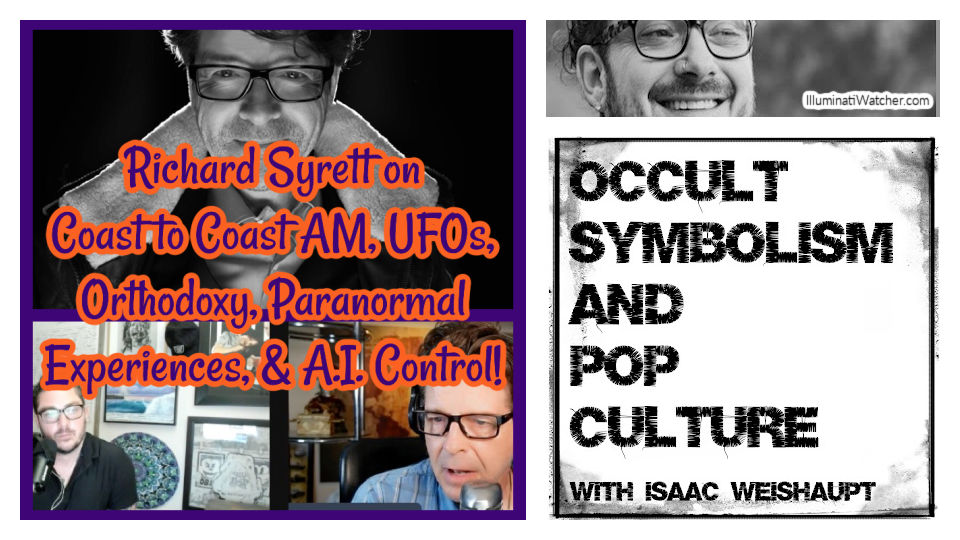
On today’s episode of the Occult Symbolism and Pop Culture with Isaac Weishaupt podcast we are joined by the legendary host of Coast to Coast AM and Strange Planet podcast- it’s Richard Syrett! This is a very exclusive interview where we get into his life journey of getting into the paranormal and hosting shows that discuss conspiracy theories, aliens & UFOs! We’ll also talk about his Orthodoxy journey and viewing the occult world through that lens, his take on extraterrestrials, interdimensional aliens, a fascinating paranormal experience Richard had with his rock historian friend R Gary Patterson, what A.I. looks like for the future of humanity, Elon Musk and how we can avoid going black pill!
NOW UP AD-FREE ON SUPPORTER FEEDS! Free feed gets it in a few days!
Links:
- Follow Richard Syrett at https://www.strangeplanet.ca (*this is where you can link to his Strange Planet podcast and get his free INNERSANCTUM newsletter as well as his YouTube channel: https://www.youtube.com/strangeplanetradio
- Follow Richard Syrett on Instagram: https://www.instagram.com/richardsyrettstrangeplanet/
- Check out my appearances on Strange Planet and Coast to Coast AM here on my new index of appearances: https://illuminatiwatcher.com/appearances-interviews-of-isaac-weishaupt/
- ONE STOP SHOP- Rumble/YouTube, social media, signed books, audiobooks, shirts & more: AllMyLinks.com/IsaacW
- SUPPORTER FEEDS: Go ad-free with HUNDREDS of bonus episodes, early access and books!
- Patreon.com/IlluminatiWatcher,
- VIP Section (*with comparsion of Apple vs Patreon vs VIP): https://wp.me/P2ijVF-aRL
- Apple Podcasts Premium! You can now go ad-free with ALL the bonus episodes on the Apple app- just open up the podcast and subscribe!
Support the show: 1. SUBSCRIBE! 2. Leave a review! 3. Go commercial free with bonus content by supporting the show on any of the THREE platforms!
(*Full transcript of the show will be at bottom of this post, scroll all the way down!!!)
Today’s show is brought to you by my books on Audible! If you want to support the show search for “Isaac Weishaupt” on Audible or hit this link to get my most popular book- THE DARK PATH!
How to Support the show:
- SUBSCRIBE!
- Leave a review!
- Go commercial free with bonus content by getting in the VIP Section, Patreon or Apple Premium!
You can search through to the ENTIRE catalog going back to 2014 at this convenient post I created:
Thanks again for all your support! If you want to stay connected please sign up for my free email newsletter which will get you updates on all groundbreaking revelations of occultism in entertainment (as well as occasional free giveaways)!
-Isaac
*When you sign up for my email updates you’ll get a FREE copy of my first full length book: A Grand Unified Conspiracy Theory: The Illuminati, Ancient Aliens and Pop Culture! Sign up here:

Isaac Weishaupt is a prominent author, researcher and host of the Occult Symbolism and Pop Culture podcast since 2014, where he explores the hidden meanings behind pop culture, conspiracies and esoteric philosophy. With a background in engineering and a deep interest in occult systems, Isaac bridges the gap between mainstream entertainment and the arcane by decoding the symbols, rituals and belief systems woven into films, music and celebrity culture. He’s written several books on Illuminati symbolism, occultism, secret societies and the paranormal. Drawing on a mix of research, intuition and cultural analysis, Isaac offers a critical yet accessible lens on the forces shaping the modern world from the shadows…
Isaac hosts the Occult Symbolism and Pop Culture podcast (supported by the supporter feeds like Patreon) and “Breaking Social Norms” podcast. He has been a featured guest on Coast to Coast AM, Tin Foil Hat podcast (honorary member of Mount Crushmore), The Confessionals, Eddie Bravo’s “Look Into It,” Ground Zero with Clyde Lewis, Chris Jericho’s “Talk is Jericho,” Richard Syrett’s “Strange Planet,” House Inhabit’s Substack, “Those Conspiracy Guys,” Dave Navarro’s “Dark Matter Radio,” Richard C. Hoagland’s “Other Side of Midnight”, SIRIUS/XM’s The All Out Show, The HigherSide Chats, VICE, COMPLEX magazine, Esquire, Newsweek, The Atlantic and many more radio shows and podcasts. His fresh perspective and openly admitted imperfections promotes the rational approach to exploring these taboo subjects and theories.
Follow Isaac on Instagram: @IsaacWeishaupt, Twitter: @IlluminatiEyes, Facebook: @IlluminatiWatcher, or sign up for the free email newsletter! Signed paperbacks available at Gumroad.com/IsaacW!
ONE STOP SHOP FOR ALL LINKS: AllMyLinks.com/IsaacW
*STATEMENT: This show is full of Isaac’s useless opinions and presented for entertainment purposes.
Full Transcript (Courtesy of all show Supporters):
*Note that this is pretty accurate- not 100% though. It’s run through software that is generally very accurate and then I give it a quick once over but there are most likely some errors.
[00:00:00] Speaker A: Foreign.
Am I excited today? It’s because I landed one of the big fish. I landed Mr. Richard Syrett, the, the
legendary host from coast to Coast AM and Strange Planet podcast. And today I’m gonna get
into his life’s journey about how he got into hosting paranormal radio shows. And we talk about
conspiracy theories, aliens, UFOs, his journey through orthodoxy and how one views the realm
of the occult through, through that lens, we get his take on extraterrestrials. Are they
interdimensional aliens? Are they grays coming to save us from ourselves? We talk about. He
shares a really amazing story about this unexplainable paranormal experience he had with his
late rock historian friend, R. Gary Patterson. Then we talk about AI and how the future of AI
looks for humanity and what this could mean. Then we talk a little bit about Elon Musk, a
continuation of our, our, our disagreements we had on coast to coast am. Heard that episode
and then he gives us his, his sage advice on how to avoid going black pill. So take a listen to this
interview. He’s an absolute legend and oh man, he’s the best. And if you, while you’re listening,
check out the links in the show notes. You can go to Strange Planet CA because he’s in Canada,
right? Not com CA. So go to StrangePlanet CA and you can sign up for his free email newsletter
while you’re listening and you can find the jump offs to his YouTube and check out his podcast.
I’ve done several appearances on his Strange Planet podcast and Coast To Coast AM and so
on.
By the way, if you want to check out those specific episodes, if you check out the link in the
show notes, I created a new web page where I’m cataloging all the appearances I’ve made over
the years. I’m, I’m still working on compiling all of them. I’ve got most of them on there, but I’ve
got all of the Richard Sirit interviews that I’ve done with coast to Coast AM as well as Strange
Planet, including my recent appearance on Unexplained with William Shatner on the History
Channel. That’s right, your boy’s on tv. What’s up now? What’s up now?
So check them all out.
Without further ado, here’s our guest of honor, Richard Sirrett.
Today we’re joined by radio royalty. He’s got the golden voice you’ve heard on coast to coast am,
five seasons of the television show the Conspiracy show and his podcast Strange Planet in the
rock and Roll Twilight Zone. He’s got years of experience researching and discussing topics
covering the spectrum of UFOs, aliens, the occult and the paranormal. He’s one of the most
respected voices in alternative media. And today I get to finally interview him and pick his brain.
Welcome to the show, Mr. Richard Cerrit.
[00:02:39] Speaker B: Hey, Isaac, great to speak with you. Thank you so much. Appreciate it.
[00:02:42] Speaker A: Yeah, thanks for, thanks for coming on here. You know, I’ve done several
of your shows and this is, we’re switching hats here. So you’re much better interviewer than me.
[00:02:52] Speaker B: Oh, no, no, no. I, I have to say in all honesty, you are one of my favorites
and I, and you’re one of my listeners favorites. That’s why I’ve had you on so many times. You
can you just continually. I, I like to use all an old hockey metaphor. Being from Canada, you
always put the puck in the net. You always deliver the goods when you come on the program. So
I appreciate you.
[00:03:11] Speaker A: Geez. Thank you. I didn’t expect that. That made my day because,
because like I said, you’re, you’re, you’re a legendary figure in this realm of, of. You know about
that? Oh, I know about it. You’re being humble. Yeah. This is, this is quite an honor. And, and
one of the reasons I wanted to have you on here is because I know how there’s, there’s several
people that like Greg Carlwood is a podcast called the Higher side Chats that I’ve done several
times and, and he interviews people just constantly. Right. And I got to think, you know, because
my podcast is mostly just me talking about my research and I think it’s fascinating how guys like
you have been interviewing guys like me for so many years. And I got to think that you’re
exposed to way more information that than, than I am in the sense that I have my own biases
and my own sort of filters of the world and my own belief systems. And I think there’s value in
guys like you who have been exposed to of wide variety of every opinion you could think of. And
I, I, I really, I really want to sort of just get a, a rough idea of how these things get internalized by
you and, and how all of this sort of formulates an opinion in your mind. And what I wanted to do
was start out with your, you know, I know that this is in that we don’t have all day, but I want to
know your life’s journey. I want to know how on earth did you become a person interested in
these taboo and fringy subjects when did those seeds get planted? Does this go back to
childhood interest?
Maybe take us on a journey of how you, you, you have gone down this path.
[00:04:56] Speaker B: Well, I’m a child of the. I was born in the 60s, but I’m really a child of the
70s, so youngest of five kids.
I spent a lot of time watching television.
I grew up watching Leonard Nimoy’s In Search of and oh, there was a program that Rod Serling
did after the Twilight Zone. It was called Art Gallery or Night Gallery, my apologies, Night Gallery
and oh, the Night Stalker. And I watched reruns of the Twilight Zone and so forth. So I guess that
was always in the back of my mind. I never set out to, you know, host a radio program dedicated
to conspiracy theories or the paranormal or UFOs.
I mean it was always an interest professionally. I mean I got into talk radio.
It wasn’t even my first choice. I was, I was intent on getting into television documentaries. In fact,
I’d interned at a TV documentary production house. And then just something popped up, as it
often does. I got a call from a classmate, hey, they’re hiring over here at this talk radio station.
And so I just kind of fell into it and fell in love with the medium and I worked, I got to work with
absolute luminaries up here in Canada in terms of talk radio. I mean the very best CFRB AM
1010 had has been on the air since 1927. It’s a 50,000 watt blowtorch station.
Toronto is like the fifth or sixth largest radio market in North America. So I was very fortunate in
kind of, you know, starting my career at the top in the sense that I’ve always worked in major
market radio.
And after about six or seven years I think I was given an opportunity to host.
That was the other thing they did there. They, they hired internally, they promoted internally, they,
and they promoted talent.
I started off as a call screener and you know, an on air and an off air producer. And then I found
myself given a late night shift on a Sunday and I had to figure out what am I going to do with this
time and, but I knew I didn’t want to talk about what everyone else talked about.
And we used to subscribe to a service called the wireless Flash actually came in the mail. All of
the producers received a copy and it helped you to do show prep and you know, there was
celebrity birthdays and the astrology, but they’re all. There were also some suggested interviews
for, for late night radio hosts. You know, hey, you want to Interview a Loch Ness monster hunter.
Here’s his number, here’s his biography and his email or whatever.
And so I just started introducing those kind of fringe elements into the program and it kind of took
off.
And the only other thing like it doing that kind of radio was Art Bell and Coast to coast am, it was
still Art Bell at that time.
He was getting close to retirement, I think.
And I was a huge Art Bell fan. I mean, how could you not? I’m just a. It didn’t matter what Art Bell
talked about. He had that kind of voice and presentation skills and ability to, you know, reach
through the radio and speak to you as if you were the only other person in the world.
And I’ve always said this. I could listen to Art Bell read from the telephone directory and I would
be captivated. And so I loved Art Bell and certainly I was inspired and influenced by Art Bell so
that those elements kind of took over the show. And then 911 happened maybe a year or two
later, and that changed everything, as it did for most people. But as a broadcaster and as
someone who was starting to sort of look beyond the headlines, it just totally took over my show.
In fact, I, within a week of 9 11, while everyone else was still, you know, sort of rally around the
flag and let’s, you know, let’s invade Iraq or Afghanistan or in weapons of mass destruction, and
it was planes flying into building buildings, I started asking some uncomfortable questions. And it
wasn’t a particularly popular thing to do on the radio at. On a major market mainstream media
station. But either management wasn’t paying paying attention, they didn’t care, or, I don’t know,
maybe they thought what I was doing had some value. I think it did.
So that really was what changed it all. I mean, I went from, you know, talking about the Loch
Ness monster and Bigfoot, and all of a sudden now I’m thrown into this world that everything we
think we know about history and, and reality and the way the world works and who’s running the
show and all of that was just turned upside down.
I was also about that. Well, maybe a few years earlier, I was introduced to a very interesting
character by the name of Nelson Thal, who remains a good friend to this day, who was a student
of the late Marshall McLuhan, Canada’s greatest mind, perhaps communications guru.
And in fact, he went on to become the official archivist for Marshall McLuhan and was going to
be a PhD student under Marshall McLuhan when the whole program at the University of Toronto
was shut down.
Which was very controversial, it turns out. I. I later Learned that Marshall McLuhan was also
studying sort of conspiracies and. And secret societies.
[00:10:55] Speaker A: In fact, he’s.
[00:10:55] Speaker B: I think he’s quoted as saying that the arts are controlled by the secret
societies.
And I later learned through my friendship from. With. With Nelson Th. That McLuhan. Now I just
lost my train of thought. Where was I going with that?
Secret societies. Oh, yes, that. That Marshall McLuhan was in contact with a lot of former
intelligence people from around the world.
Whistleblowers and. And.
And things like that. So this was entirely new to me. Anyway, Nelson Thaw also introduced me to
a book. I remember having dinner with him one night and he had a shopping bag with him and
he grabbed this big hefty book and he put it on the table, the restaurant. And it was Tragedy and
hope by Dr. Carol Quigley, who was a professor at, I think, Georgetown University, taught Bill
Clinton and others. And he was sort of blowing the whistle on, you know, the Rockefellers and
this and the secret societies, the roundtable, Arthur Rhodes and so forth, because he had
access to the Rockefeller libraries. Actually, he wasn’t so much a whistleblower. I think he. He
actually was agreeing with what they were doing. But he. For whatever reason, he felt compelled
to let the world know.
So that was kind of my introduction. That’s a very long answer. But that’s how I kind of.
I got into it and I’ve. I’ve never looked back. I mean, once you. You drink from that, well, you’re
never really content to sort of go back and covering, you know, city hall meetings and provincial
budgets. It just.
It just really doesn’t matter anymore after, you see. After you sort of have pierced the veil, so to
speak.
[00:12:46] Speaker A: That’s fascinating. In fact, I have been taking a course with Professor
Diana pasulka and Marshall McLuhan’s name came up several times. I casually know who he is,
but I don’t know much about him besides the.
The ideas he presented about technology being technology. Having the capacity to either, you
know, make our lives more enriched by freeing up the times, the time for humanity to sort of
pursue creative endeavors and things versus what I think in my negative outlook, what I think
the technocrats are really going to do with it. And that’s. Enslave us or something.
But that’s interesting. It’s. Sometimes I get into these synchronicity things because I’ll have one
obscure reference that just keeps popping up on my radar. So I guess I gotta really dig into
Marshall McClone a little bit. Sounds like.
Because you brought him up too.
[00:13:45] Speaker B: Yeah, I mean, most people are familiar with his book the Medium is the
Message.
But he also had, as you say, he had a lot of things to say about technology. And I’m not an
expert on Marshall McLuhan by any means. It comes to me second hand from, you know, a
pretty good source. His official archivist and a student.
But he talked about how technology erases identity and violence is a quest for identity. And so
technology, I guess, inadvertently leads to violence and technological, the major technological
advancements are always followed by war.
[00:14:26] Speaker A: Wow.
[00:14:28] Speaker B: And he, and he talked, he, back in the 1960s, he basically predicted the,
the Internet.
He, you know, famous for talking about the global village and so forth. He talked about how we
are since the, since the launch of Sputnik, this, this satellite, the Russian satellite, We have been
sort of pulled out of our bodies really. We are living at the speed of light. We’re electronic,
electronic beings living at the speed of light in our, you know, our, because of technology and
satellite technology and global communications, we’ve sort of been, I don’t know, transported out
of our bodies. You know, we’re all sort of bouncing around in the ether up there, you know.
[00:15:22] Speaker A: Right, right. Yeah, I know exactly what you mean.
[00:15:25] Speaker B: Yeah, yeah.
[00:15:25] Speaker A: And it’s like we’re projecting our consciousness into this digital, you know,
Internet world. And, and I, I feel a bit of that too, as a content creator, podcaster, it’s, it’s almost.
And then on top of that, I use a pseudonym of, of Isaac Wiseau, which is my real name. And,
and it, you get a sort of schizophrenia about you with this, like, I’ve got my real personal life and
then I’ve got this sort of online life and they’re two different versions because I’m not, I’m not that
interesting or engaging in my personal life. People are probably, you know, no, you know, people
in my personal life, when they find out I podcast, they, they don’t really talk to me about it, which
I, which I don’t know if I should be comfortable with that or not, but I don’t bring it up and they
don’t talk about it. And they probably think, who, this guy, he’s, he’s so laid back and quiet, I can’t
imagine he talks to people, you know, about podcast stuff. But yeah, I, I, I, I’m totally with that.
With the technology sort of changing who we are. And that’s, and that’s a, I want to, later on we’ll
talk about AI Because I, I do think that that’s a huge component of, of this revolution that we’re
sort of witnessing. I, I, I don’t know. I, I’ll pick your brain about that here in a minute.
But, but I wanna, I, this is kind of a more personal question maybe, so feel free to tell me to shut
up. But the, I want to know how your spirituality sort of filters because, like, for me, I’ll start with
my sort of perspective. Me as a, I call myself a lukewarm Christian because I’m not a good one,
but I’m an Orthodox Christian and I believe. I just, you know, I was really hardcore for. When I
first found orthodoxy in 2003, I was hardcore for a solid, probably 15 years of, you know, didn’t
miss church, read every book. I was really into it and it kind of petered out. And it’s not that I am
jaded by it or against it or anything. I just kind of fell out of practice and now it’s like, okay, it’s a
core belief of mine and that’s kind of where it is. And I, and I try to live my life as a Christian the
best I can, but when I study all of these paranormal, occult, conspiracy topics, it really starts
jumbling up the works in my brain about what’s, what’s really going on and, and such. So I’m
curious how your experience of spirituality playing into all of these sort of dark and taboo
subjects, how do you sort of navigate that?
[00:17:49] Speaker B: Well, I’m, I’m also an Orthodox Christian. I married into the, into the faith.
[00:17:54] Speaker A: Oh, same, Same as me. Yeah.
[00:17:56] Speaker B: I was, I was raised in the United Church, which used to be called
Methodist, and it was a, I mean, I had a, in many ways an idyllic childhood, you know, and I, I
wanted to play hockey, so I played in the church hockey league. But the deal was, if I went, if I
wanted to play hockey for the church, I had to sing in the choir or I had to go to Sunday school. I
did both.
It was wonderful sort of fellowship. But looking back, it was, while it was high in fellowship, not a
lot of worship going on. It was great sense of community. But then, and then I married my lovely
mighty Aphrodite. And I not only fell in love with her, but I fell in love with her faith. And I
became, I was Chrismated.
I’d already been baptized, so I was Chrismated into the Orthodox faith because I wanted to
share sacraments with, you know, we’re planning on having children and we had two, two boys.
And I’m. Well, to cut to the chase, I’m constantly conflicted by the topics that I present on my
podcast and I’ve presented on various talk radio programs on different stations.
This, I mean, it’s been different incarnations of the same sort of, you know, the conspiracy show,
Conspiracy Unlimited, Strange Planet, and I then coast to coast and so forth. But I, yeah, it’s a,
it’s a challenge for me. I am constantly conflicted. But I, I do cling to, I cleave to the faith.
You know, I’m not someone who can quote scripture chapter and verse.
I have, I have kind of a childlike faith, I guess, really just some might call that naive or some
might call that, you know, unsophisticated.
I just, I trust in the Lord and, and you know, I just, I accept Jesus Christ as my Lord and Savior
and, and nothing else really matters. I mean, as long as I think you believe in, in the birth and the
death and the resurrection of Jesus Christ, the rest is really details.
But for me, I love the mysticism of the Orthodox church, but it’s a lot of the things I talk about
and you talk about, you know, whether it’s the cult and the paranormal and I just got off
recording a podcast earlier today about Carlos Castaneda and you know, sort of navigating the
liminal realms and alternative realities. And earlier this week I was talking to people about DMT
entities.
I mean, and these are all, and I mean, I try to provide a very respectful and safe platform for
people to come on. It’s not an argumentative type of program.
So, you know, reincarnation, that’s something else. I don’t subscribe to reincarnation.
Some people believe that it was in the Bible and it was taken out of the Bible. I don’t believe
there’s any evidence for that. But still, I mean, people come on and they talk about that, but I’m,
I’m conflicted, Isaac and I, and the deeper I get into the faith, the more I’m conflicted.
I don’t know, maybe, maybe I’m in the wrong business.
[00:21:25] Speaker A: Yeah, there’s, there’s a, there, there’s something to be said there and I
think that it’s a, it’s a double edged sword for me because I’ll research a lot of these topics and
I’ll honestly, I, I’ll see some validity in some of the occult arguments and I’ll have to sort of just
have the faith and, and research. Okay, what’s the ORTHODO like for Gnosticism, for example,
they think we live in this prison planet. And, and I, and at first I’m like, that’s crazy. But then I like,
the more I dig into it, I’m like, I don’t know, maybe that’s not so crazy because the whole idea is
that I forget, I think it was Iapetus or somebody was sort of hired by the early church and you
know, 300 A.D. to be, do a disinformation campaign against the Gnostics to make sure that that
flavor of interpretation of who Jesus Christ was didn’t become the mainstream Christianity. And I
think, well, that is kind of weird. But then I have to sort of go through the people that have spent
way more time researching this than me and that’s like the church fathers and the orthodox sort
of dogmas and literatures and say okay, well they’ve already crossed this bridge hundreds of
years ago. So I guess I just got to have the faith that their version is correct. But, but I, if you
hard pressed me on it, I’d say man, it really just comes down to a belief and, and I, I don’t know
the answers.
So it’s, it’s just, it’s really hard because the more you, the more you research these things, it’s
the more those seeds get planted and you start questioning like, well, maybe it is a big control
system in a way.
So. Yeah, that’s interesting that you brought that up. The, the, the, the, the, the other side of that,
sort of the other side of the question.
I’d like to know what you feel about extraterrestrials, aliens, UFOs, UAP, whatever that is.
Because my, you know, that was one of the things that got me into this realm growing up in the
80s and 90s was I was fascinated by the topic of aliens. And, and I didn’t realize there was a
spiritual component to that.
I just thought it was a they exist or they don’t kind of thing. And I’d like to know what you think.
You’ve interviewed so many guests that are researching this thing intensely and now we’re living
through this strange moment of possible disclosure that’s coming any day now, maybe, who
knows?
I know that’s a big open ended question, but what’s your sort of view on extraterrestrial life?
[00:24:02] Speaker B: Well, first of all, I have to say it, it never ceases to me to amaze me.
The hunger, the insatiable appetite for this subject for, for listeners, whether it’s the podcast or
coast to coast they, people cannot seem to get enough of it despite the fact, you know, we’ve
been, they’ve been talking about disclosure for, I don’t know, 20 years or more.
I enjoy talking about it. I mean, there are different, you know, so many different facets. Whether
we’re talking about the, you know, abductions or we’re talking about crop circles, or we’re, we’re
talking about UFO propulsion systems or the whole disclosure or, or exopolitics, how the ET
reality is impacting, you know, geopolitics and so forth, underground bases and reptilians, it just
goes on. It’s never ending.
[00:25:00] Speaker A: Right.
[00:25:01] Speaker B: But again, not, I hope this isn’t a turn off for, for people, but I, you know, I,
for me personally and from time to time I will sort of divulge my, my biases and I, I put everything
personally on a personal level. I put everything through my faith filter. And so it’s no different with
the ufo, ET issue.
As far as I know, there’s nothing in the Bible that denies 100, denies the existence of other, you
know, races or entities on other planets.
But it doesn’t. The only way it makes sense to me, based on my, my faith, is that they’re not
extraterrestrial, they’re interdimensional.
And that is in the Bible.
And that’s the spiritual aspect of this. If we look at these incursions and we look at Genesis 6
and we, and, you know, fallen angels and the nephilim and so forth, it makes sense then from a
biblical standpoint, a lot of fans of the UFO genre or whatever you want to call it, are not happy
with that because it has sort of become a religion on its own. All on its own.
Those people that see extraterrestrials as, you know, the, you know, knights, white knights
coming to save us from ourselves and, and taking people on board their craft and showing them
videos or movies of, you know, how we’re destroying our planet and we need to raise our
consciousness and join the, you know, Intergalactic Federation or whatever they call it. And I’m
not trying to be flippant here. I mean this, these are their sincere beliefs. So I, but that doesn’t
make sense to me.
But I’m not going to stop, you know, allowing those people to come on the program and, and talk
about it.
I have an audience that, that is hungry for that kind of information that’s, you know, that’s what
they want to hear. So I give them what they want to hear. And from time to time, yes, when,
when appropriate, I think I’ll, I’ll offer up my, my perspective, which again is, is a biblical one, that
these are interdimensionals and there is a, there is a, a sizable camp that believes that as well,
that we’re talking about interdimensionals.
Some. If we’re talking about the angelic realm, it makes sense. You know, there are demons,
there are fallen angels, and then there are the, the good angels, if you will. The messengers of
God.
And they’ve been interacting with, with humanity since forever. So it makes sense from that point
of view, if that answers your question.
[00:28:02] Speaker A: Yeah, that’s great. There was actually a. One of the first times I listened to
Strange Planet. I think he had two episodes and I can’t for the life of me remember the name.
There was these two guys, I want to say they were brothers and they were, they were more in
the Christian camp and they, they talked a lot about the occult and aliens and I think they’re the
ones that got me onto Tom Horn’s research.
But. And they talked about the Watchers and the nephilim and stuff. I can’t remember their
names. Saved the life of me.
[00:28:32] Speaker B: But it does ring a bell. Let me just.
[00:28:35] Speaker A: Farley Brothers. Does that sound familiar? The Farley Brothers or
something like that?
[00:28:38] Speaker B: No, there was, I was thinking Justin Fall.
[00:28:42] Speaker A: That’s it. Fall. Yes.
[00:28:44] Speaker B: Might be F, A, U, L. And yeah, his brother.
They made documentary films.
[00:28:49] Speaker A: Yes, that’s them. Yes. Yeah, yeah, I’ve been, I, I’ve. Because I, I casually
listened to the episode forever ago and, and I, I never was able to figure. I’m gonna write that
down. The Fall Brothers. They, they. Because I even bought a one or two of their documentaries.
They were really good.
But yeah, it’s, it’s. They, they were great guests. They had fascinating information.
[00:29:11] Speaker B: Yeah, they talked about Jack Parsons from the Jet Propulsion Laboratory
and his association with Aleister Crowley and using the same kind of ritual with Babylon Rising
type ritual out in the desert in 47, supposedly opened up this portal.
And that’s coincidence. Coincidentally, perhaps, when the whole 47 UFO flap started. Then he
dies in a, an explosion at one of his labs and without, you know, closing the, closing the portal
and the speculation, this is what led. Because it wasn’t just a UFO flap in 47. I mean, people
were seeing and having all kinds of very bizarre encounters and experiences in 47. It wasn’t just,
you know, Roswell and the Aztec UFO incident. I mean, there was a whole host of paranormal
things that were going on. We Always focus on Roswell. But, you know, it’s a great question.
Was that all tied to Jack Parsons?
And I think L. Ron Hubbard was involved as well. Yeah, it’s a fascinating chapter, for sure.
[00:30:21] Speaker A: I really feel like that is the core thing that this goes back to. And I had
interviewed Dr. Jacques Valet a few weeks ago. And you know, he’s, he’s, he’s the, there’s two
guys that I think understand how the occult works with technology and aliens, and that’s, that’s
Dr. Jacques Valet and Peter Lavenda. And, you know, because Dr. Valet basically was part of
the team that created Arpanet, which created the Internet, he’s been researching UFOs forever.
And when I talked to him in my assessment of what he was telling me, I, me reading between
the lines of what he’s saying. I think what he was saying, he refers a lot to, to occult ideas in his
new book, Forbidden Science 6. And he talks about alchemy and all kinds of stuff. And I, and I, I
think what he was trying to say is that if we want to understand the phenomenon and UFOs and
what this really is, we have to go and look back at previous practices that may have been
shunned or dismissed. And I, I believe that he’s talking about occult stuff like alchemy, even
ritual magic and so on. And I, I think that this goes back to like that whole idea of the Collins
Elite, which I believe is where the Fall brothers were talking about all of these things. And, and
there’s not a lot of people that are talking about it, because when I was researching for my UFO
books is, I think, is when I stumbled on it because I was like, okay, yeah, these guys are onto it.
Like, not, not too many people talk about all these connections. And I think that when it comes
down to it, it’s, I think that there’s occult practices being done to garner knowledge from these
entities.
And from there, I don’t know how that fits into the world of the nuts and bolts people that believe
in ufo crashes. But Dr. Jacques Valet and Paola Harris wrote a whole book about the 1945
Trinity crash that happened, you know, right after the atomic bomb got detonated, which opened
up the riff. And then, you know, then you have Parsons doing all the rituals of the Babylon
working, and then the 47 Roswell crash. And I just think that there’s something there and I think
that it’s tied into occult practices. And I don’t know, I’m just throwing that out there.
[00:32:39] Speaker B: No, I, I, I Agree.
And, and it seems to me.
[00:32:46] Speaker A: It’S.
[00:32:46] Speaker B: Been a couple years since I interviewed Jacques Vallee, but he seems to
be based on sort of titles of books and conversations, snippets that I’ve heard coming around to
the idea. I mean, I think the word deception is used in one of his book titles, talking about the
alien agenda and the, and deception being involved. And along with another alien abduction
researcher, David Jacobs, also increasingly talking about the deception. I mean, what is the
alien agenda? Now, David Jacobs is, I don’t believe he’s.
He holds religious views, but he does believe that the, the agenda involves a human alien hybrid
program.
Essentially, the, the end goal is to raise, is to, to colonize Earth, to take over the planet through
this program. And Nick Redfern is someone else, popular UFO researcher, author, who’s sort of
come to this conclusion as well. Now, I don’t know if Valet is entirely come over to that camp, but
again, he seems to be, at least to my mind. I might be wrong, but moving in that direction sort of
as a, as a response to this, I mentioned, you know, ufology becoming this religion where, where,
you know, the Raelians and, and, and people who really buy into this idea that, you know, ETS
are here to save humanity, they’re going to solve all of our problems, they’re going to provide us
with free energy. And, and if people that are abducted by aliens, which to me just sounds, you
know, like just absolute barbarism, poking and prodding and, and, and abducting children, the
response from the UFO religious crowd, if I can use that term, is that, that this is a contract
we’ve made in a prior life. So this is where sort of the convergence of, you know, reincarnation,
New Ageism meets ufology.
A lot of people actually believe that there is nothing, nothing wrong with abducting children.
Aliens abducting children. This is a contract, a soul contract that we’ve made in a previous life. I
mean, I just can’t countenance that idea. But that’s, you know, that’s, that’s out there.
[00:35:19] Speaker A: Wow, that’s interesting. Yeah, that’s. And, and there’s a, an element of this
that I think because I tie a lot of my research into pop culture because, you know, I grew up
watching lots of television and movies and, and I, you know, still enjoy all those things to this
day. A lot of people get turned off by that. A lot of people, A lot of people get upset and they say,
well, if you’re finding all this symbolism and, you know, demonic activity on these movies. Why
are you still watching them? And I’m like, I don’t know what to tell you. I still enjoy them. It just is
what it is. And I, and I can’t help but think that the pop culture stuff sort of directs us in our line of
thinking.
And I don’t know where our fantasies and imagination starts and where the reflection of reality
happens.
For instance, you know, Jack Parsons and Werner von Braun, they were really into these
science fiction tales about, you know, us going to Mars and things like this, and that inspired
them. And they really built rockets. And, you know, I personally don’t think that we put a man on
the moon, but there’s, you know, they, they were able to sort of launch these massive rockets
and there’s space station out in, you know, synchronous orbit. So, I mean, there’s elements of
that that really manifested as reality.
What, what do you, you know, you, you, you had a podcast called Rock and Roll Twilight Zone,
talking about pop music or rock music, I should say. And so you, you’ve got some interest in, and
I know we talked previously about.
You’re interested in Frankenstein, right? Like, like you, you, you enjoy Frankenstein. I do too. I’m
a big universal mon.
You know, as a child I grew up, I was like, terrified of Frankenstein. I used to have this recurring
nightmare about Frankenstein, for whatever reason. And I would, I would see, there’s, there’s a
term for it, but I would see like my, I could see my dad’s chair and he would have, like, he would
put his, like, work uniform on it, and in the middle of the night, I would look over there and I could
see it. I was always thought it was Frankenstein looking at me, right? And, but growing up and
as a researcher now, I say, oh, like, it’s a whole story about alchemy and man becoming God
and stuff, you know, so, so, so maybe, maybe take us down the path of pop culture and your,
your interest. What, what kind of pop culture were you into and how does this play into the
research for today?
[00:37:46] Speaker B: Let’s see.
I was, from my earliest memory, I was into, you know, the, what do they call them, the four Ds?
Dylan, the doors, the dead.
That’s three. What am I missing? Anyway, Dylan, the Doors. Today, I, I, I was out of sync really,
with my generation because I sort of came of age in the, the early 80s and everyone was into,
you know, Duran Duran and, I don’t know, Spando Ballet and all of that stuff. And I was, I was
into classic rock and music from the 60s in the psychedelic era, I guess, because my older
brother and sisters, you know, they had quite an album collection. And so I just, that was what I
was fed and that’s what I gravitated towards.
And then the rock and roll twilight zone, that was, that came about because through.
Was it the conspiracy show or I forget what the, what the name of the show was.
Back in the CFRB days, I was doing a late night show talking about all of these things, you
know, paranormal conspiracies. And I met our Gary Patterson, who was a rock and roll historian
and was. He kind of wrote the definitive book on the whole Paul is Dead legend.
[00:39:09] Speaker A: Oh yeah, yeah, yeah.
[00:39:11] Speaker B: I think it was called.
What’s it called? Paul was the Walrus or something like that.
Anyway, so Gary or Gary, I called him Gary. He became kind of a semi regular on the show and,
and he just, he wrote again entire anthologies about all of these rock myths and legends and
curses, you know, Leonard Skynyrd and all, you know, dying in this horrific plane crash in the
late 70s. And, and all of, you know, the 27 Club, all of these musical icons that died at 27, you
know, Brian Jones and Jim Morrison and. Or did Jim Morrison fake this, fake his death and did
Brian Jones really drown or was he murdered? And on and on it went. It was just, it was such a
rich vein that we decided to do. We were going to collaborate and do a.
A terrestrial radio program. It was going to be called the Spirit of Rock. And we. Spirit, kind of a
plan, words, spirit, the paranormal and so forth.
And we talked about that project almost every day for about two years.
And we were pretty close to landing our first station. We, Our idea was to build kind of a
network. We’re going to syndicate this show called Spirit of Rock. We had produced a pilot. The
first one was about Jimi Hendrix and whether he was murdered by his.
His. His manager, who was former MI6. And we had Jimmy Jimi Hendrix, former road manager,
the late Tappy Wright on the program.
And he, he claimed that the, the manager, was it Mike Jeffrey, I think his name was Mike Jeffrey
Hendrix manager had confided in Tappy Wright that he had murdered Jimi Hendrix for the
insurance.
And so we produced the pilot. We were a couple days away from meeting with the management
at a radio station in Knoxville, Tennessee, because that’s where Gary lived, near Knoxville. That
was going to be our first station. And then I learned on coast to Coast AM that Gary had died.
Oh, but the previous.
That was a Saturday night.
The previous, actually it was Announced on Coast to Coast.
I. I slept through it. Usually. I listened to coast to Coast. My. My wife, the mighty Aphrodite, and I
usually stay up and listen to coast for some reason that night. I slept through it. I missed it.
So I woke up the next day and I got a.
A Facebook mention, I think it was, or Facebook message from Dave Schrader, who was one of
the guest hosts at that time, telling me. He said, hey, I know that you and. And Gary were close.
I just wanted to let you know in case you missed the show last night. Gary passed away
yesterday.
And I didn’t believe it because I had.
I had, or I thought I had a fairly lengthy con. Telephone conversation with Gary that night.
It was a Friday night. He called me. I remember seeing, you know, his name up on my, you
know, when the phone rang. I don’t answer the phone unless they’re in my contact list. And his
name came up R. Gary Patterson.
And that had that all familiar Tennessee drawl. And he was such an affable, lovable person,
always upbeat and positive and always saying supportive things about me. And. And we were
talking about our project, and he mentioned to me that the meeting that we had scheduled for
the management at this radio station in Knoxville about our radio program had to be postponed
because it was the Memorial Day weekend. And so Monday was going to be a holiday. And I
completely forgot about that.
And he said a couple of other things that were kind of. At the time. I thought, well, that’s unusual,
but that’s just our Gary.
[00:43:20] Speaker A: He.
[00:43:21] Speaker B: He said to me at one point during the conversation, you know, Richard,
you’re a really cool dad.
I thought, okay, well, I’m not sure where that’s coming from, but, you know, thank you. And then
he said something. He said, you know, Richard, you and I are a really big deal.
And I thought, well, that’s just Gary’s way of, you know, trying to boost our morale as we’re trying
to launch this project and so forth.
And then I asked him, I said, it’s Memorial Day weekend coming up. I said, when I think of
Memorial Day in the United States, I think, of course, the. The parades, but I also think of family
barbecues. I said, gary, you’re going to have a barbecue this weekend. And for the first time in
the year, all the years I had known Gary, he got kind of sharp with me.
And he said, there will be no barbecue.
And I thought, oh, boy, did I just step in a landmine or something? Is there something going on
with his family?
He just Said, just like that, there will be no barbecue. And I just kind of let it go. And this is going
back to 2017. I.
The details are getting a little foggy, but I remember wandering through the house with my cell
phone to my ear and I would just suddenly find myself in a different room and not realize it was
like I was walking in a dream or something, I don’t know. And at one point I walked through the
kitchen and my wife was in the kitchen with my brother in law. He was sitting at the kitchen table.
They saw me with the phone to my ear, wandering around in the house. And then anyway, the
phone call ended.
I don’t even remember exactly how it ended. I know it. It was kind of on a sore point. And then
the next day I learned that, that Gary had passed away. So I ran upstairs.
The mighty Aphrodite was just getting out of bed, getting dressed and I said, gary passed away.
Gary died, I just learned on Facebook.
And she said to me, weren’t you talking to him last night? I didn’t, I didn’t, I didn’t prompt her for
that answer. She just volunteered it. She said, I saw you on the phone. And I. And I figured it
must have been Gary because we were always talking.
And so I went down to the funeral. I’m making this a very long story. I apologize. But I went down
to the funeral, I flew down to Knoxville and then from there I went to his little town.
And there’s Gary in his open casket with his. I think he had a Fender guitar. He was a wonderful
musician in front of the casket. And there was his older brother Mike. I went up and introduced
Mike and he said, oh, Gary spoke of you often. Thank you for coming all this way. And I didn’t
want to tell him about the phone call, but I had to know. I said, what time did Gary pass?
And he said, oh, it was about five o’. Clock.
Well, that night when I talked to him, it was well past dark, I remember.
And this was May, late May. So it doesn’t get dark up here in Toronto until probably past 8 o’.
Clock.
Anyway, one thing I neglected to mention was I looked on my phone, you know, at the morning
after he passed away and you know, you can go to recents on your phone and find out who did
you call. Outgoing calls. Nobody called me on Friday. There were no ingoing or outgoing calls.
There was a call from Wednesday from our Gary Patterson. I remember talking to him on a
Wednesday.
There was nothing on the Friday when he died. When I, I Talked to somebody.
[00:46:48] Speaker A: Wow, that’s fascinating. I think that those kinds of paranormal stories,
because I’ve got a couple too that are just unexplainable. And, and I think it’s like sometimes that
veil gets thin and you know, there’s no, there’s no way to like prove it when it, when it happens
sometimes. So that, that’s, that’s interesting that would happen. So did you. So what was the
next move after that? Did the, did you just proceed with the project on your own?
[00:47:15] Speaker B: It took me a few weeks to think about it. What would Gary want me to do?
Yeah, and I decided.
Well, one of the last interviews, I think it was the very last interview that Gary did talking about
his books and, and, you know, rock mysteries and so forth forth, was with Chris Jericho.
Chris Jericho, the famous w.
Well, used to be called the WEW World Wrestling Federation and then they changed their name
anyway, a famous wrestler. But he became, he was, he’s also a musician. He became a, a
podcaster. And so Chris Jericho had interviewed our Gary Patterson the last time just a few
weeks before he died. And it was Chris Jericho who was on coast to coast that night to
announce with Dave Schrader that Gary had passed away again. I missed the, I missed the, the
show. So I reached out to Chris Jericho and I said I was a good friend and, and partner with our
Gary Patterson and we had this project together and I’m thinking about now doing a podcast.
And Chris had a podcast network and he said, well, I’m going to be in Toronto in a couple of
weeks or a couple months or whatever it was. Why don’t we meet? So I met him down at the,
the Royal York Hotel and told him about the idea and he loved it. And so I produced about 40
episodes of the Rock. I renamed it the Rock and Roll Twilight Zone. Partnered with. It was the,
the Jericho Network and it became kind of a, a documentary style podcast. It was a hell of a lot
of a work. A hell of a lot of work. I’m very proud of it. I think Gary would, would like it too. I think
he would have loved it actually.
But that’s how that came to be.
[00:49:00] Speaker A: Oh, that’s awesome. Yeah. Yeah, I’m sure, I’m sure he’s grateful for, you
know, following through on that. The, the.
I’m watching a show on Netflix called, I think it’s called Pantheon. It’s like a anime show. And it’s
interesting because that segues into my sort of last question I’ve got for you. Well, second to last
question, then I’ll let you go.
The. Because in the storyline it’s about AI and this, this guy that’s able to successfully upload his
mind to a sort of digital matrix thing and he’s able to communicate electronically with his wife and
he calls his wife and that’s, that’s, that just made me think of that. Which takes me to my next
question for you. And you said something when, when you, you had me on coast to coast
recently.
The, you said something that kind of blew my mind and I’ve been thinking about it ever since
because we were talking about AI and you said something to the effect of how.
Well, we didn’t really have a choice with AI it’s just kind of rolling out. And I thought that’s
interesting.
I guess I sort of drank that Kool Aid of me just being an insignificant person and just like, oh, this
is just what they do. And you’re absolutely right. It’s, it’s, it’s this thing that we’re told by the, the
greatest minds and the tech elites that on the one hand they’re like, oh, this is going to kill us
and it’s going to be the end of humanity, but in the next breath we’re rolling it out with no
limitations. And I, and I just sit back and I say, oh, that’s kind of scary. What do you think, what
do you think the future holds for us? And, and how’s AI component of this? Is this kind of one of
those inflection moments that they’re telling us is going to happen? What do you perceive?
[00:50:42] Speaker B: Yeah, just to follow up on, on our conversation on coast for those who
missed it. Yeah. We never had, we were never let in on the conversation, you know, do you want
driverless cars? I mean, think about the job displacement. We talk about the robot apocalypse,
hahaha and the singularity and so forth, but we never, there was never any discussion as far as I
know, in the House of Commons and here in Canada or on Capitol Hill in Washington. Do we
want driverless cars? Do you want robots serving you hamburgers? I mean, think about the
implications.
Something like, what is it, one in five jobs in the United States anyway, probably similar up here
in Canada, are tied to driving a vehicle. Whether we’re talking about taxis or Ubers or limo
drivers or truck drivers or school bus drivers or etc. Etc.
Think of the job displacement. And it’s not like a recession or even a depression where
eventually, you know, those jobs come back. We’re talking about millions and millions and
millions of jobs and they’re not coming back.
So I mean, I think AI holds a lot of promise. It’s, you know, it’s the, the double edged sword. I
think AI could, could solve or cure eventually most diseases.
It could solve resource scarcity.
But then I look at the unchecked development risks, you know, creating a world where humans
essentially are obsolete and we have to ask, are we, are we playing God? Well, not, we’re not
playing God.
Somebody’s playing God.
I’m thinking of Genesis in the Tower of Babel.
So I, I don’t understand AI. I’m trying to play catch up here because, you know, I, I understand a
little bit about chat GPT. If I, if, or if I want to do a quick search, maybe I’ll use Grok and we’ll
utilize AI when we’re producing. My son helps produce the thumbnails for my YouTube videos
and he uses AI and they’re terrific.
I mean it’s amazing. I just, I’ve seen some amazing videos now and it’s, and it’s, they’re getting
more and more realistic.
Someone did a parody of we are the world from 1985, you know, with Bob Dylan and Michael
Jackson. But now that they’re using all of the world leaders, Donald Trump and Benjamin
Netanyahu and, and Giorgio Maloney and I mean, and Vladimir Putin, it’s, I don’t know if you’ve
seen it, but it’s, I am absolutely enthralled by it. But also, and then I step back and I think, oh my
God.
You know, in, it’s like John Madden’s NFL, that video game. Every year it got more and more
realistic. You know, in the beginning it was very pixely and then it got a little bit better, more fluid
and so forth. And now I can’t tell the difference between a video game and an actual game. I
have to, you know, look really close.
So this is where we’re at with, with AI right now.
I, I shudder to think where we’re going to be in. Never mind. Five years, six. How about six
months?
[00:54:06] Speaker A: I agree. I, I, the videos is, the, the videos is the thing that really makes me
wonder because I’ve seen like, like I said, within six months I’ve seen the, the, the AI generated
photos and videos improve so much that now I’m a little bit terrified and I’m worried that this
thing’s gonna sort of disrupt us too much too fast. And yeah, I’m not sure what to think of it. But,
but quick question. You mentioned Grok. Did they. Did Elon Musk let you back onto Twitter yet or
what? An X?
[00:54:40] Speaker B: No. Which is kind of a head scratcher because I, like many people, I was
absolutely, I was in such a celebratory mood when, when he took over Twitter and here I am now
it seems like I’m in permanent Twitter jail. Even though they’re supposed to be the new
champions of free speech, I still have no idea what I, what it was I did, except that I did post
some, some videos very critical of globalist Mark Carney, our new prime Minister up here in
Canada. So I don’t know, we have, you know, we have an X office up here in Canada. Whether
someone from the liberal government picked up the phone, who knows, who knows how that
happened? But no, I’m, I, I’m in permanent read only mode on X. Oh, I see.
[00:55:29] Speaker A: So you can still. Okay. And, and I tell people, I, people asked me how the
coast to coast thing went. I said, you know, we had this fun little exchange because it turned out
Mr. Sir is an Elon Musk fan. And I was critical of you. I thought, and I thought that was fair
because I mentioned how Elon Musk questioned something about, you know, how empathy is
holding us back or something as humans. And, and you, you corrected me, which was a fair
correction. I, I think I did. I thought when I first found that thing that within the context it was
accurate. But then you reread the context. I mean, I thought, you know, like, I think, I think
you’ve got a fair point. Like, I think I do. So, and this is my biases and my sort of like tunnel
vision of like, paranoia about the tech elites and, and the world’s richest man kind of stuff. And I,
I think it’s interesting and, and, but you’re an Elon Musk fan. Is that, is that true? Like, what do
you, do you think that he’s, he’s got good things in mind for us?
[00:56:28] Speaker B: Or again, the word conflict has to come up. I am conflicted. I mean, you’ve
opened my eyes as well. When we were talking, we were talking about the Dark Enlightenment
on, on coast and also on my Strange Planet podcast, which I encourage everyone to, to listen
either if you’re a Coast insider, go back and listen to the, the episode with Isaac or on, on
Strange Planet.
You really opened my eyes. I mean, I, I appreciate Elon Musk’s.
I mean, he’s, he’s so audacious and, and although now I’m learning things about, you know,
whether is he Actually, the guy that’s doing this, or did he just kind of take the credit for it?
You know, he’s been called a fake and a fraud. Everyone is a fake and a fraud, apparently these
days. I don’t know what the truth is.
I do have an admire, an admiration for, for him. I certainly liked, at least on the surface, what he
was attempting to do with the Department of Government Efficiency.
Well, some other people, I think maybe even you pointed this out. Was this all an attempt to
access data to get back in some way against his, his adversary over at OpenAI? Sam Altman, or
Scam Altman as he calls them? I mean, was that really the motivation here? That it was nothing
to do with, you know, making government more efficient and, and reducing the budget or
reducing the debt? It was about getting back at Sam Altman from, From the get go. So I don’t
know. The answer to that is. I am also conflicted by neuralink. I mean, this is something that.
To say it keeps me up at night is a cliche, but I do. It does bother me. You know, building this
brain computer interface to conceivably merge our minds with A.I.
you know, it’s. It’s pretty bold and it’s, it’s almost mythic when you think about it, like something
out of a sci fi epic. But I mean, I’m thinking about, imagine curing paralysis or restoring vision or
unlocking new levels of human potential. I mean, I, I’m drawn to that. I really am. But it also
comes with a serious caveat. I mean, who controls that ship?
Who gets access to your thoughts, your memories, your, Your consciousness?
And you know, the potential for, for surveillance, for manipulation, for straight up dystopian
nightmare scenarios. I mean, that just.
That’s off the charts. The potential there for bad. I mean, it’s. Again, it’s.
I’m conflicted by it.
[00:59:10] Speaker A: Yeah.
[00:59:11] Speaker B: Plants get hacked, right?
[00:59:13] Speaker A: And, and that’s what one of the topics in, in the. Professor Dana Pasalka’s
class that I just, Just wrapped up was how AI is sort of forcing us to question what does it mean
to be human? And we’re sort of looking and, and I agree. I think ner. I think that’s beautiful. The
idea of, of people who are paralyzed being able to walk or to see again, like, I don’t know, that
we should stop that, even with the negative side effects. I just don’t know. It’s. It’s interesting.
Time to be a philosopher, I’m sure. There’s, there’s so many things going on with that, with that.
And in fact, I, I’m planning on writing a book about the Dark Enlightenment and I’m, I, but the
problem with that is my research keeps growing as to how many books I need to read and I’ve
got two on my, on my, literally on my desk right now that I’m trying to hack through. And then my
friend Jimmy Hanshaw messaged me some interesting excerpts from the book about Elon Musk.
But it’s a massive, you know, six, 700 page book about Elon Musk. It’s kind of the most famous
one, the biography of him. And so now I’ve got to add that to the list too. So I, I, the jury’s out for
me and Elon Musk, I, I tend to label him evil. And that’s like my, my fear of techno elites and ultra
wealthy people. That is why I think that. But, but there’s room in there that I could be wrong for
sure.
[01:00:35] Speaker B: So, I mean you, you certainly opened my eyes, I have to give you credit
there. But I mean, the, the other thing is now his mad rush to this backup plan for humanity and
the rush to get a colony on Mars.
What does he know that we don’t know?
That’s what I’m asking.
[01:00:54] Speaker A: Yeah, interesting stuff. One last question. I’m going to let you go.
What, what do you think?
So the, the thing I like to talk to and you’re, and you’re a great person to ask this question too
because I, I try to talk to my guests who know so much and when we’re navigating this crazy
world of conspiracy, it’s easy to go black pill, meaning you’re, you’re negative outset and outlook
of everyone. And, and this is what contributes to people who are like, oh, you need to, you know,
burn all society to the ground. And, and I, I think that goes too negative sometimes, but it’s hard
because you, you, you talk about, when we talk about these subjects of conspiracy and
interdimensional aliens and Satan and all these things, it’s easy to become too negative and be
scared and fearful and, and I don’t think that’s the right answer. I don’t, I don’t, I try not to sort of
put that into my listeners either because I don’t want to make people’s days worse or make them
full of fear, even though these are very real fears and concerns.
Do you have any advice on how we can sort of stay focused on researching these topics yet not
go to black pill?
[01:02:03] Speaker B: That is a challenge I mean I, I really compartmentalize my life in that
regard.
Typically I’m not, you know, at the breakfast table with my family talking about these things
unless they bring, you know, unless my, I have twin boys who are 18, unless they bring it up.
But it’s important to sort of build that firewall between what I do, you know, on the podcast or on
coast and, and then the rest of my life. I had a terrestrial radio show up until recently that was
entirely different. It was, it was news and politics and the culture war and, and, and so forth. But I
mean occasionally the two worlds would collide. I mean, because, you know, today’s conspiracy,
give it six months and it’s tomorrow’s headlines, right? And so a lot of what I used to talk about
on the conspiracy show, you know, the deep state and all of that, that’s just, that term has just
become a cliche. Everyone’s talking about the deep state now or the globalists. Ten years ago
nobody used that term in mainstream media. So the worlds are colliding. But what I found, I had
to step away from that show in part because you know, things up here in Canada are pretty
bleak.
We just re elected a Liberal government after 10 lost years and the, the prime minister we have
now is arguably worse than the previous one. Except he’s, he’s worse in that he’s probably
smarter, he’s a former banker. So I was, I was almost blackpilling myself. I thought I had to, I
have to step away from this. But again I, I, I’m going to come back to my faith. He asked me
what prevents me from being black pilled.
You know, I think, I think the Bible offers a lot of hope.
I have to look at this chaos in terms of, you know, it’s not random, it’s part of God’s sovereign
plan.
I always say, you know, we, I’ve already seen the movie. We know how it ends. The good guys
win.
In the meantime, we’re, we’re being called as Christians to be watchmen, to discern the signs of
the times, share the gospel, shine a light in the dark, offer hope, you know, to a world that’s kind
of spiraling towards control and deception.
And we have a choice really.
We submit to, to God or we surrender to man made systems. And you know, again we know the,
the end of the story.
Christ wins and, but until then we have to resist tyranny, we have to defend truth and we have to
ultimately, I guess, trust in God’s providence. So yeah, the future is fraught. With, with
challenges, but it’s also an opportunity for faith to shine.
And in the meantime, again, we have to navigate AI and globalism and, and surveillance and
attacks on freedom. And you know, ultimately we have to anchor ourselves. For me personally,
anyway, in, in, in scripture, beautiful advice.
[01:05:13] Speaker A: I agree with you. I agree with you wholeheartedly. That’s why people,
people get upset and scared about what about the digital matrix. And I think, well, you know, I, I
think you just gotta, you gotta have your, your faith where and wherever you find it.
And for, for me and you, you know, it’s orthodoxy.
[01:05:30] Speaker B: So.
[01:05:31] Speaker A: Yeah, thanks, thanks for sharing all this with me. I, I, I. One last thing. Can
you, can you, you’re all over the place. You got, you got Coast to coast, you got Strange Planet,
and you’ve got this really cool newsletter called Inner Sanctum.
Tell people where, where they can find more of Richard Sirrett.
[01:05:47] Speaker B: So the best thing to do is to visit the website strangeplanet Ca not dot
com. We’re up here in Kanakistan in Canada. So it’s the.comstrangeplanet CA. If you go there,
you can see my, my most recent podcast, all of the Pod. You can stream all of the podcasts from
there. We’re up around 12, 20 episodes I think now.
And you can subscribe from there. You can become a premium subscriber, which basically is
commercial free listening when you get some bonus episode. And you can also subscribe. You
mentioned the monthly newsletter Inner Sanctum. That’s the official newsletter of the podcast
range Planet. It comes out once a month, absolutely free.
We just did.
The June edition was all about cloning and MK Ultra and body doubles and so forth.
So again, StrangePlanet ca. And for those of you who want to know when I’m on Coast to Coast
AM next, all the dates are there on the website as well. Everything right there. Strangeplanet Ca.
[01:06:57] Speaker A: Perfect. All right. And I’ll put those links in the show notes for everybody. I
know you’re a busy man, so thank you so much for, you know, spending the time with us and,
and you know, you’re, you’re, you’re a treasure in this world of conspiracy paranormal. You’re a
legend. So thank you so much. Appreciate it.
[01:07:10] Speaker B: Oh, thank you, Isaac. I appreciate the opportunity and introducing me to
your audience and, and I, I really appreciate you too. You’re, you’re likewise.
And I look forward to our next conversation on coast or Strange Planet.
[01:07:24] Speaker A: Absolutely. Cheers.
What a guy. What a guy. How can you not love that guy?
You gotta love his voice that, that’s a million dollar voice right there. I can only dream of having a
voice that silky and smooth.
So I hope you enjoyed that interview. He’s a guy I really look up to. I love the guy. Check out his
podcast Strange Planet. I’ve been on there several times and like like he said he hosts coast to
Coast AM and I’ll put a links in the show notes as you already know strangeplanet ca where you
can find the link to his YouTube channel as well as his inner sanctum newsletter.
And if you want to find my specific episodes you you know how to google and stuff you can do
that or you can go to my website.
The link is in the show notes. If you go to all my links you can see I added a link to appearances
and interviews and you you can find it there as long with all the other appearances I made on
like tinfoil hat and donut and all kinds of stuff. So thanks for listening to the show. Thanks for
supporting the show. Until next time, stay positive.