Quick Links:
- Support the show! https://wp.me/P2ijVF-aRL (Go ad-free, unlock 100’s of bonus episodes, early access!)
- ONE STOP SHOP- AllMyLinks.com/IsaacW (Rumble/YouTube, social media, signed books, audiobooks, shirts & more)
- CopyMyCrypto.com/Isaac is where you can copy James McMahon’s crypto holdings- my listeners get access for just $1!
LISTEN TO THE FREE FEED VERSION OF THE SHOW HERE:
Listen to the free feed version of the show on the Apple Podcasts or Spotify, or any of the podcast apps- I’m on just about all of them (**and don’t forget to leave your reviews there as well!!**); or right here on the embed (*if you’re looking for one of the ad-free SUPPORTER feeds you’ll have to stream it through their respective apps):
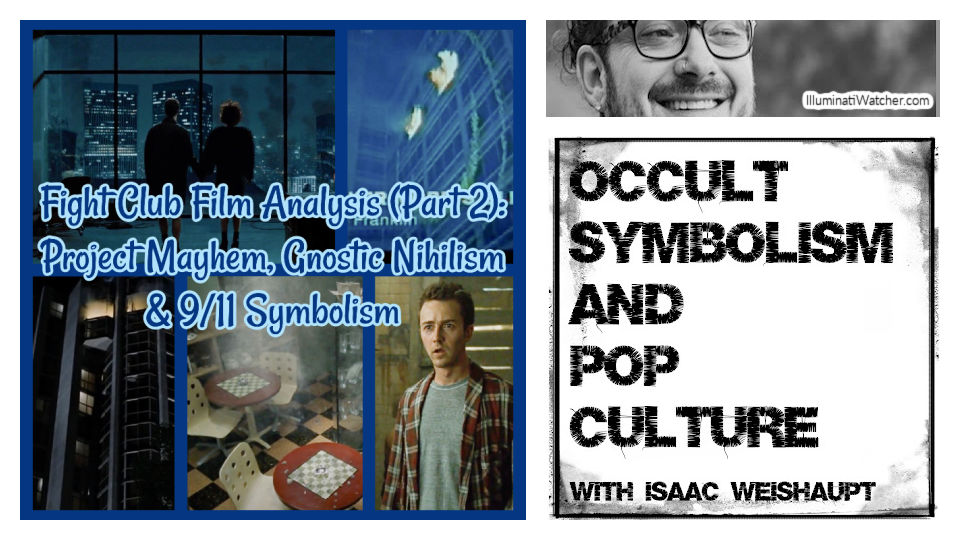
On today’s episode of the Occult Symbolism and Pop Culture with Isaac Weishaupt podcast we’re wrapping up our deep dive into Fight Club! We’ll finish the film and break down all of the symbolism we’ve been witnessing in the conclusion of this ritualistic initiation into practices of MKULTRA alters, Gnostic Nihilism, human sacrificial soap, red pill manosphere, consumerism manipulation of mankind and 9/11 predictive programming! Join along as we hit the bottom of the Abyss through the ultimate death and rebirth ritual of Project Mayhem!
NOW UP AD-FREE ON SUPPORTER FEEDS! Free feed gets in a day!
Links:
- Fight Club Film Analysis (Part 1): MKULTRA, Freemasonry, Human Sacrifice & Shadow Work! https://illuminatiwatcher.com/fight-club-film-analysis-part-1-mkultra-freemasonry-human-sacrifice-shadow-work/
- ISAAC’S ONE STOP SHOP- Rumble/YouTube, social media, signed books, audiobooks, shirts & more: AllMyLinks.com/IsaacW
- SUPPORTER FEEDS: Go ad-free with HUNDREDS of bonus episodes, early access and books!
- Patreon.com/IlluminatiWatcher,
- VIP Section (*with comparsion of Apple vs Patreon vs VIP): https://wp.me/P2ijVF-aRL
- Apple Podcasts Premium! You can now go ad-free with ALL the bonus episodes on the Apple app- just open up the podcast and subscribe!
Support the show: 1. SUBSCRIBE! 2. Leave a review! 3. Go commercial free with bonus content by supporting the show on any of the THREE platforms!
Today’s show is brought to you by my books on Audible! If you want to support the show search for “Isaac Weishaupt” on Audible or hit this link to get my most popular book- THE DARK PATH!
How to Support the show:
- SUBSCRIBE!
- Leave a review!
- Go commercial free with bonus content by getting in the VIP Section, Patreon or Apple Premium!
You can search through to the ENTIRE catalog going back to 2014 at this convenient post I created:

Thanks again for all your support! If you want to stay connected please sign up for my free email newsletter which will get you updates on all groundbreaking revelations of occultism in entertainment (as well as occasional free giveaways)!
-Isaac
*When you sign up for my email updates you’ll get a FREE copy of my first full length book: A Grand Unified Conspiracy Theory: The Illuminati, Ancient Aliens and Pop Culture! Sign up here:

Isaac Weishaupt is a prominent author, researcher and host of the Occult Symbolism and Pop Culture podcast since 2014, where he explores the hidden meanings behind pop culture, conspiracies and esoteric philosophy. With a background in engineering and a deep interest in occult systems, Isaac bridges the gap between mainstream entertainment and the arcane by decoding the symbols, rituals and belief systems woven into films, music and celebrity culture. He’s written several books on Illuminati symbolism, occultism, secret societies and the paranormal. Drawing on a mix of research, intuition and cultural analysis, Isaac offers a critical yet accessible lens on the forces shaping the modern world from the shadows…
Isaac hosts the Occult Symbolism and Pop Culture podcast (supported by the supporter feeds like Patreon) and “Breaking Social Norms” podcast. He has been a featured guest on Coast to Coast AM, Tin Foil Hat podcast (honorary member of Mount Crushmore), The Confessionals, Eddie Bravo’s “Look Into It,” Ground Zero with Clyde Lewis, Chris Jericho’s “Talk is Jericho,” Richard Syrett’s “Strange Planet,” House Inhabit’s Substack, “Those Conspiracy Guys,” Dave Navarro’s “Dark Matter Radio,” Richard C. Hoagland’s “Other Side of Midnight”, SIRIUS/XM’s The All Out Show, The HigherSide Chats, VICE, COMPLEX magazine, Esquire, Newsweek, The Atlantic and many more radio shows and podcasts. His fresh perspective and openly admitted imperfections promotes the rational approach to exploring these taboo subjects and theories.
Follow Isaac on Instagram: @IsaacWeishaupt, Twitter: @IlluminatiEyes, Facebook: @IlluminatiWatcher, or sign up for the free email newsletter! Signed paperbacks and shirts available at OccultSymbolism.com!
ONE STOP SHOP FOR ALL LINKS: AllMyLinks.com/IsaacW
*STATEMENT: This show is full of Isaac’s useless opinions and presented for entertainment purposes.
Transcript:
[00:00:00] Speaker A: Today we’re wrapping up our deep dive into the film Fight Club. We’re going to finish this film. We’re going to break down all of the symbolism that we’ve been witnessing in this exciting conclusion, in this ritualistic initiation into the practices of MK Ultra alters, Gnostic nihilism, human sacrificial soap, red pill manosphere, consumerism, the manipulation of mankind, and 911 predictive programming joining along as we hit the bottom of the abyss through the ultimate death and rebirth ritual of Project Mayh.
Now, in part one, we talked about the cast and the crew. We got into the first part of this film analysis by breaking down what was happening in Fight Club. And today we’re going to jump right back into the action for the second half of the film where Narrator and Tyler were discussing how to make soap. And we resume the action with the red hot burner of a scene where Narrator is becoming enlightened through pain.
Take a listen.
[00:00:58] Speaker B: You’ll hurt more than you’ve ever been burned.
[00:01:00] Speaker A: And you will have a scream.
[00:01:01] Speaker B: What are you doing? Guided meditation. Worked for cancer. Could work for this.
Stay with the pain. Don’t shut this out. No, no, no.
Get your hand. The first hope is made from the ashes of heroes. Like the first monkey shot into space. Without pain, without sacrifice, it would have nothing. I tried not to think of the.
[00:01:17] Speaker A: Word serum or flesh.
[00:01:19] Speaker B: Stop it. This is your pain. This is your burning hand. It’s right here. Who’s going to my cave? I’m going to my cave. I’m gonna find my powers.
No. Don’t deal with it the way those dead people do. Come on. Get the boy. Okay. No. What you’re feeling is premature.
It’s the greatest moment of your life, man, and you’re off somewhere missing. I am not.
Shut up. Our fathers were our models for God. If our fathers failed, what does that.
[00:01:47] Speaker A: Tell you about God?
[00:01:49] Speaker B: Listen to me.
Consider the possibility that God does not like you, never wanted you. In all probability, he hates you. This is not the worst thing that can happen. It is it. We don’t need him. We don’t agree.
Fuck damnation, man. Redemption. We are God’s unwanted children?
[00:02:07] Speaker A: So be it.
[00:02:09] Speaker B: Listen, you can run water over your hand and make it worse or. Look at me.
Or you can use vinegar to neutralize a burn. Please let me have it. Please. First you have to give up.
First you have to know not fear.
Know and someday you’re gonna die.
You don’t know how this feels.
It’s only after we’ve lost everything that we’re free to do anything.
Congratulations.
One step closer to hitting bottom.
[00:03:00] Speaker A: So in the scene, Tyler throws chemicals onto the narrator’s hand, and he tries to get narrator to become enlightened by focusing in on the pain instead of distracting and externalizing and going outside of his mind.
He also talks about how God doesn’t really love us because our fathers bailed on us and God probably hates us and we definitely don’t need him.
And he forces the narrator to give up before his will neutralizes the burn. And giving up means to know that someday you’re going to die. This is the Memento Mori. This is what we were talking about in part one with all this death and rebirth stuff. And we tied it into the film Memento, which is, you know, similar in certain ideas, but it’s all about the death and rebirth. And this is one of the many initiation scenes that we witness where Tyler, the shadow of narrator, is initiating our main character into this new line of thinking.
And he says, you’re one step closer to hitting the bottom. Now, in the book, the soap is explained as a metaphor for human sacrifice. That’s right. So it’s more than just making soap because when you watch the film, you don’t really get that in its totality. You have to actually read through the book where he explains there’s a more in depth process of the philosophy through his initiation.
I’m gonna read you from the book. It says, don’t shut this out. Tyler says soap and human sacrifice go hand in hand.
Then later on in the chapter, after, after he’s already burned narrator’s hand, he says something else interesting. He says, open your eyes.
Tyler says. And his face is, you know, he’s like, covered in tears, right?
Congratulations, Tyler says. You’re a step closer to hitting bottom.
You have to see, Tyler says, how the first soap was made of heroes. Think about the animals used in product testing. Think about the monkeys shot into space. Without their death, their pain, without their sacrifice, we would have nothing.
And the whole book turns out to be about a spiritual component to human sacrifice. Embracing it almost, which is concerning on many levels, right? We talk about the wild theories about human sacrifice going back to Moloch, right?
But we also see some of this idea of embracing this nihilistic view of human sacrifice through the order of nine angles with the human calling and all kinds of weird stuff, right? Like it’s a recurring theme and it ties into the worship of Saturn. All right?
Which is. I keep teasing it because I keep. I’m still working on it. I’M working on a deep dive into what Saturn means. What? Why do they worship the Cube?
[00:05:44] Speaker B: What.
[00:05:44] Speaker A: Who is Saturn? Why do want to sacrifice people to Saturn? Well, Saturn is the sort of outermost adversary and it represents the guardian of the final initiation of mankind. It’s like the final boss of the occult. Right, but we’re going to unpack all that. We’re going to talk about the real life Saturnian cults that do sacrifice.
So. So be sure to stay subscribed to my show. However you’re consuming this show, make sure you’re hitting the subscribe button, all right? And tell a friend. Tell a friend.
So the whole book basically is about human sacrifice. Project Mayhem is rolling out and we hear that each one of the initiates is tasked to murder, kill. 12 human sacrifices.
Now, it’s not super crystal clear if they actually do murder. It’s not like it walks you through the scenes of them killing, but it clearly says that each initiate has to make 12 human sacrifices.
And it’s not very clear if they go through it. But there’s a scene where they talk about how they have to give Tyler 12 driver’s licenses to prove that they did it.
And in the film, you can see this at the end.
It literally has a wall in the. The Fight club house and it says human sacrifices across the top and it’s a wall full of driver’s licenses.
So I propose that really happen because in the film you see a very watered down version where he takes a guy’s driver’s license and, you know, threatens him with it, which I think we talk about later on. So we’ll save it for that.
And then the other idea here is, well, we’ll talk about humans, we’ll talk about the, the scene with the veterinarian, because it actually shows up later in the car scene.
But at this point, Bob, remember Meatloaf? He’s. He stops the narrator walking the streets to say how much, you know, he loves Fight Club and, you know, so on. And you, you sort of see foreshadowing of the reveal about who Tyler is and who narrator is at this point.
So now we’re back into Tyler’s philosophies and he’s giving a big speech about how they’re actually in a spiritual war, right? Namely against capitalism. But you saw all the seeds he was planting about how God really hates us earlier on and the idea of embracing human sacrifice.
He says in here, you know, this, this capitalism has us buying that we don’t need, right? So it’s very, very Anti materialism. Very anti capitalism.
And at this point, Lou from Lou’s Tavern, I’m Lou, shows up, and he’s there to break up a fight club. And Tyler, being the messianic figure that he is, he allows Lou to assault him repeatedly in front of everybody. And then he actually gets the upper hand. He jumps on top of Lou, and he’s bleeding all over the place, and he bleeds all up into Lou’s face and mouth. And this somehow changes Lou’s mind. And he’s like, yeah, just get off me. You can do whatever you want.
So they can continue to use the basement of Lou’s Tavern.
Tyler is going forward with Project Mayhem, and he gives everyone an assignment. They are supposed to pick a fight with a stranger, and specifically, they’re supposed to lose the fight.
And the narrator assures that this is not as easy as it sounds, because most people avoid getting into fights, and they go through a variety of scenes about this.
Then narrator goes into his supervisor’s office, and he basically blackmails his workplace with the information about the formula of how they choose to do car recalls or not.
And. And this kind of ties into the human sacrifice element, because capitalism is okay with human sacrifice on some levels. It’s okay with people dying for the sake of saving money.
And that’s kind of the big critique of capitalism, is it’s not a very humanistic economic system.
And at this point, narrator starts beating himself up in front of a supervisor, and he’s demanding. He’s like, you’re gonna cut me some checks, fool. I’m out of this dreaded day job. And I think, man, does that work? Maybe. Maybe someone needs to try that and see if it works.
So he starts beating himself up until the supervisor finally agrees to put him on the payroll as an outside consultant. So now they can do Fight Club every night. There’s no dreaded day job. Perfect. Right.
Tyler starts handing out assignments to everyone, and it’s basically a lot of sort of pranks. It’s kind of like, you know, very, very much jackass.
Like, I think this is pre jackass, too, by the way, if I’m not mistaken, some more sort of predictive programming of the future.
And they. They do a bunch of pranks like putting tire spikes in the wrong way. You know, those tire spikes that. That fold down when you drive over them to go wherever? Which. Fun story. Me and Jimmy the Jimmy the Jackhammer had a great theory. One day, he said, dude, I don’t think those spikes do anything. I said, what do you mean? Of course they do something. They blow up your tires if you go the wrong way.
And then we sat and we unpacked it, and I was like, bro, you’re totally right. It doesn’t make any sense.
It doesn’t make any sense. In fact, if you look it up. Look up the. There’s like, a. We were Googling around to see if anyone drove over these tire spikes the wrong way to see if they really blow up your tires.
And I saw a YouTube video from, like, the 80s, and it was like this big, scary, dramatic scene of someone going the wrong way over those spikes and, like, the car blows up, you know?
But none of it makes any sense because usually you see these at car rental locations by the airport, right? To keep people from. I don’t know. I don’t know what they think they’re doing. Steal the thing and drive out. I don’t get it. I don’t really understand what the purpose is. Right.
But neat. But either way, even if you were like, well, the spikes are there to prevent you from driving the wrong way.
Okay, so you’re telling me these car rental companies are gonna let you, like, first off, you have to understand, like, the. The masses, the public are pretty dumb. We’re not good at following directions. We’re not good at paying attention.
Especially when you’re in a new city, in a new airport, you’re thinking about how you got to get to the meeting on time. You got to get your hotel room. Like, you’re thinking about things, right?
This is a foreign environment. So you’re telling me that a car rental company would deal with multiple people a day driving over these spikes and having them blow out their tires?
That would be so expensive and so annoying and so chaotic to just constantly hear, boom. You know, like. Like, that’s crazy.
So our theory is that even if you drive on them the wrong way, I think those spikes would drop down. Either way, I think it’s all a facade. I think it’s a fugazi.
So shout out Jimmy the Jackhammer for thinking that one through. I was like, dude, you’re totally right. Now, we tried to test this one time.
We’re like, well, let’s just drive over the wrong way, and one of us will film it, and we’ll see. We’ll expose the truth to the world.
But the reality is that programming, that brainwashing is so deep, even though I firmly believe that those things go down and you won’t blow up tires, we couldn’t do it. We couldn’t do it. I Couldn’t test the theory. I didn’t have enough hair on my nuts to do it. So if anyone out there wants to prove or disprove this theory, I’m receptive to seeing the evidence. But I’m definitely not advocating you try it. Because. Because it is possible, baby, they do blow up. I mean, that would be terrible, right? But have you ever.
Ever seen anyone drive over it the wrong way and blow their tires up? Have you ever heard anyone talk about it? You would think, on accident, multiple people a day do this.
You think it would be this crazy thing. So anyway, I do believe that they don’t work, but I’m not telling you that they don’t because I don’t want you to blame me when the tires blow up. But anyway, the. I am curious if anyone’s seen or proven that those things don’t work. So, anyway, if fight clubs are putting tire spikes the wrong way, they’re feeding birds so that they poop all over people’s cars.
They.
They go into a liquor store for human sacrifice. This scene with the human sacrifice, just a variety of things, right? But at the scene where they go into the liquor store, it’s his narrator and Tyler for this mission, and they pull out the clerk and they put a gun to his head.
And his name is Raymond. He asked Raymond, he’s like. He’s like, what would you rather do than be sitting here wasting your life working at a convenience store?
And, you know, the. The clerk is. Raymond’s freaking out. He’s crying because he’s like, oh, my God, I’m about to die.
And he says, well, I wanted to be a vet. Veterinarian, right? So Tyler says, well, okay, I got your driver’s license. And if in six weeks, we come back and you’re not on your way to becoming a vet, then we’re going to murder you.
So you can see there’s a bit of a concept here of terrorizing people into having a better life and pursuing their goals.
And I think it’s about counteracting all the subliminal and subconscious programming of marketing and capitalism.
So in the film, we see Tyler, they’re cutting out articles for. From the news, you know, talking about all these Project Mayhem assignments, one of which in particular is titled Performance Art Molested, or Performance Artist Molested, I should say, which is very strange, right?
Not sure what it means if you zoom in and read the text. It doesn’t. It’s just a bunch of nonsense. Like, it doesn’t say anything, really.
So Tyler also starts having Applicants show up at the house for those that want more training and what they’re supposed to do, he tells narrators, like, what we have to do is we keep rejecting and insulting these applicants. And if they stick around, if they continue to wait into the house after verbal abuse and stuff, then they’re perfect for the job, right? They really want to get in.
And once they get in, they shave their heads.
Tyler keeps insulting him, calling the all singing, all dancing crap of the world. Again, refer to part one, where we talked about that whole exchange, calling him and Marla, calling each other human butt wipe.
And they’re. They’re going into nihilistic ideas and even says. Tyler even says stuff about how they’re all going into the same trash heap. Like, this is a very dark, bleak view of humanity, right?
And this is very similar to how the Eleusinian mystery cults of Greece would operate. You know, they would. The initiates would have to fast, they would have to isolate, they would have to go through these, what they call Dionysian practices of purification to abstain, right?
And the Pythagoras, we talked about part one, all the numerology of the phone numbers and apartment number for Marla Pythagoras, he of course had a cult as well, a secret society, I should say.
And any initiate that wanted to join was required to take a five year valve silence before they could be initiated. So to take some verbal abuse on the porch for a week or so, like, you know, in the scheme of things, not so bad, right?
So anyway, everyone’s in the house, they’re watching the news, and there’s a news story about the Parker Morris building.
And you see that basically they put a giant smiley face and fire, you know, they blew out windows and started a fire, makes a big smiley face.
And this is, of course, you know, Project Mayhem stuff. Now, completely unrelated, maybe, possibly, is William Ramsey, who I’ve added on the show a few times, and a few years ago we had him on and he was talking about his research into the smiley face killers.
And it’s this idea that there’s serial killers that murder and there’s always like a smiley face logo near the victim, right?
Now, David Fincher, the director, interestingly enough, has a very clear interest in serial killers. He did films like Seven. He did shows like Mindhunter. He did a movie called the Killer. I haven’t seen that yet.
But he’s interested in serial killers. So I question if that’s maybe not another nod to William Ramsey’s theory about the smiley face. Killers.
So meanwhile, the police, they are trying to crack down on crime. And this is during the same news segment, right? They show the building all blown up, and they interview the city police commissioner. He’s like, we’re gonna crack down on this crime. And he’s going to do it through what he calls Project Hope. Now, you have to understand, the city commission doesn’t understand or know about Project Mayhem. So the iron. The irony that they would be called Project Hope as an opposing polarity is, you know, done on purpose, I believe, because Tyler and Project Mayhem are basically causing all these problems in the city, and the commissioner is trying to counter that chaotic force with a force of order, Project Hope. And we’re going to go more into the idea of opposing polarities at the end of the episode in the conclusion, right?
So Project Mayhem and Tyler, they don’t like the commissioner talking like this, so they. They basically kidnap them, take him into a bathroom, and they threaten to cut his balls off. Now, what’s curious, if you look at this scene, which, if you’re. Look, if you’re watching the video version of this, I’ll show you the image. And if you’re on the Patreon or VIP section, consider going to Tier 2, where you get the video version of every single show. I do ad free, early access, the works. If you’re on, like, YouTube or Spotify and you’re like, well, where’s the video? I want to see the video. Like, sometimes I’ll put most of them on there. It depends.
I’ve got a lot of censorship issues that prohibits me from just publishing everything I do. So some of my shows are on YouTube and Spotify and all that. Some are not. Okay?
Now, what’s interesting is that when this bathroom scene occurs, you’ll notice that they give him the.
[00:20:10] Speaker B: The.
[00:20:11] Speaker A: The.
The scare tactic of cutting off his nuts on a black and white checkered tessellating floor, which, again, represents the opposing forces. And you see these in Freemasonic lodges on the floor. They call it the Moses pavement. The. Which references the. The muses channeling through divinity.
But specifically in the movie, this is meant to reinforce the tension between chaos and order, right?
Project Ma’ am is chaos. Project Hope is the order. And the guy who’s introducing Project Hope, the opposing polarity, they’re like, you’re not going to do that. We’re not going to be goatin with the Bobs here. We’re not. We’re not balancing forces because these are opposing sort of threats now. And recall the beginning of the film the very beginning. Meatloaf. Meatloaf. Bob said, losing all hope is freedom.
So this is kind of like a discordian idea. They. They love the idea of chaos. They want to embrace it and sort of like, let all the chips fall where they may. Literally a line from the movie.
So the narrator starts feeling a little bit out of the loop, and he’s like, man, they’re doing all these Project Mayhem assignments, and because they can’t talk about Project Mayhem, he doesn’t even know what they’re doing. And he’s kind of like, what the hell happened here? He’s losing his, you know, sense of ego as narrator. And Tyler is taking over the shadow.
So during one of the fight club nights, Narrator takes it all out on Jared Leto, and he just literally bashes his face in.
And Tyler says, where’d you go, psycho boy?
And then he takes him for a car ride to really sort of lay in some of more Tyler philosophy.
And he does the same thing to narrator that they were doing to the convenience store clerk. Raymond gives him the driving. It’s rainy. They’re driving in the car, and Tyler’s talking to narrator, and he was like, if you died, what do you wish you would have done? And Tyler even lets go of the steering wheel, and he puts on his seat belt, and he’s like. He’s like, I’m not touching the steering wheel. Like, this is pure chaos.
And he allows the car at full speed to ram into a parked car, and of course, car accident, whatever, right now. In the book, the day after narrator beats up Jared Leto’s character, Tyler calls him Psycho Boy. And right here is where he invents Project Mayhem, which turns out to be a project to initiate the entire world into Tyler’s philosophy and force the entire world to go through the death and rebirth ritual and to hit the bottom, quote, unquote.
I’m going to read you from the book. Says Tyler told me later that he’d never seen me destroy something so completely.
That night, Tyler knew he had to take Fight Club up a notch or shut it down.
Tyler said, sitting at breakfast the next morning, you looked like a maniac, psycho boy. Where did you go?
I said I felt like crap and not relaxed at all. I didn’t get any kind of buzz.
Maybe I developed a jones. You can build up a tolerance to fighting. And maybe I needed to put move on to something bigger.
It was that morning Tyler invented Project Mayhem, because, as you already know, Tyler is the shadow of narrator.
Right? He says, maybe I need to bump it Up a little bit. And then Tyler is like, yeah, we can bump it up. Project Mayhem.
Tyler asked what I was really fighting. What Tyler says about being the crap and the slaves of history. That’s how I felt. I wanted to destroy everything beautiful. I would never have.
Burn the Amazon rainforest, pump chlorofluorocarbons straight up to the. To gobble the ozone.
Open the. See, now listen to my lung. My. My. Young folks listening. See, back in the day, in the. The 90s, there were these things called CFCs, chlorofluorocarbons in, like, hair sprays and stuff, and they would eat up the ozone layer, and that was a big thing. We worried about the ozone layer back then, putting holes in it. And I think the irony is that the science is in the opposite perspective now. And it’s like, maybe they want holes in it so they can release the carbon dioxide gases into the space. I don’t. Don’t ask me. I’m not a scientist.
But it was a big deal. You used to put it on hairspray cans, said no. CFCs and all this stuff.
I guess that problem has been addressed. I don’t know. I haven’t heard about this in about 25 years.
Let me get back to the book. He says, open the dump valves on super tankers and uncap offshore oil wells. I wanted to kill all the fish I couldn’t afford to eat and smother the French beaches, beaches I would never see. I wanted the whole world to hit bottom.
Now, this is very much incel culture.
We can probably blame Fight Club for all of the incel culture that we see today.
This is a very destructive idea that just because you can’t experience something, everyone else needs to pay the price for it.
I don’t need to go on. You kind of get what I’m saying?
And he talks about how he doesn’t get a buzz from fighting the. You know, anymore. That’s why he kept beating in Jared Leto’s face. And so the next day, Tyler invents Project Mayhem, which, ironically, also has a bunch of support groups. Again, this is mirroring a sort of as above, so below mapping of the beginning of the film, where narrator is at a support group, and the leader of the support group says, I look around and I see a lot of new faces. Which is exactly what Tyler says at Fight Club. Right.
I think it’s the same night that he invents it after he beats before narrator beats up Jared Leto, by the way.
But Project Mayhem has a bunch of little mini support groups within and this is kind of. And they, in the book, they describe them better.
But this is kind of also like sub projects within the umbrella of MK Ultra, right?
And the idea is that Project Mayhem is indicating that Tyler, that narrator, and the shadow Tyler are graduating to needing more and more violence. And now they want to initiate the whole world into their dark philosophy.
And this is very much dark enlightenment, right? This is about destroying everything, burning it all down and starting all over.
Now, we also read about one of the sub projects is called the Assault Committee. And this is where we get into the. It’s murder of the Project Mayhem. The human sacrifices.
I’m going to read you from the book.
This was the goal of Project Mayhem. Tyler said, the complete and right away destruction of civilization. What comes next in Project Mayhem, nobody knows, except for Tyler. The second rule is you don’t ask questions, don’t get any bullets. Tyler told the Assault Committee.
And just so you don’t worry about it, yes, you’re going to have to kill someone, all right?
Arson, assault, mischief, and misinformation. No questions, no questions, no excuses and no lies. The fifth rule about Project Mayhem is you have to trust Tyler.
Now, this is graduating to a very much Charles Manson esque cult, right? You have a cult leader that you cannot question.
And there’s an agenda here, right?
So narrator wakes up, Tyler’s gone, and the house is full of the applicants and the initiates working, the space monkeys, they call them in the book. And the narrator has no idea what these people are or what they’re doing for their Project Mayhem assignments.
And an emergency happens. Bob shows up. Well, he gets carried into the house. He was on assignment to destroy corporate art and take down a corporate coffee shop, and he got shot in the head. So the applicants bring him in and throw him on the table, and he’s dead. Right?
Now they play a little video recap of this, of this event, of this scene.
And if you look at the coffee shop, the floor is again, this sort of tessellating squares pattern, this black and white checkered floor of the Free Freemasonry.
Furthermore, they show two chessboards, right? Which is again, this, you know, 64 square Freemasonic idea. It’s the opposing forces.
So Bob’s dead, they want to bury him. And the narrator says he’s upset because he was friends with him on some level. And he and Project Mayhem, like, they don’t have names. And he’s like, no, this guy had a name. His name was Robert Paulson.
And everyone in there, of course, cult like fashion Starts chanting his name.
His name is Robert Paulson.
Because in Project Mayhem, they decide in death, you get a name.
It’s very much like. Reminds me of.
And this is very much like Saturnian death cult ideas, right? This is kind of like what you see in the Mad Max movies, where they. The. What do they call them? The rowdy boys, the guys that huff silver paint.
They want to die because they get to go to Valhalla if they die, a warrior.
So that’s kind of what this is. It’s like the ultimate level of brainwashing.
Narrator goes all over the country. He’s trying to find Tyler now. He’s like, dude, what the hell’s going on? So he goes to all these different cities. Turns out there’s a fight club in every single city. Ironically, the fight club has been franchised like a corporation and spread all over the world here.
And the people in each city that talk to Narrator, they’re. They’re kind of implying that Narrator is Tyler Durden.
And narrator’s like, why did they think I’m Tyler Durden? So he goes to his hotel, he calls Marla. He’s like, have we ever had sex? And she’s like, you’re a psychopath. And he’s like, well, seriously, though, have we? And she’s like, yeah.
And boom. All the. All the pieces fall into place. And this is the big reveal.
Narrator is Tyler Durden. Okay? And when they play this scene, which I’m gonna play the clip for you here, it’s it. They go through all the flashbacks and stuff, and basically, we confirm at this point that Tyler and Narrator are, in fact, the same person. Take a listen.
[00:30:34] Speaker B: I’m coming over. No, wait, Marlon, I’m not there.
You broke your promise.
You talk to her about me. Like, what the is going on here? I ask you for what? One thing. One simple thing. Why do people think that I’m you?
Answer me.
Shit.
Answer me. Why do people think that I’m you?
I think you know.
No, I don’t. Yes, you do. Why would anyone possibly confuse you with me?
I. I don’t know.
You got it.
No. Do not with us. Say it.
Because.
Say it.
Because we’re the same person.
That’s right. We are the All Saving All Dance Crack. I don’t understand.
You were looking for a way to change your life. You could not do this on your own.
All the ways you wish you could be.
That’s me.
I look like you want to. Look, I like you want to. I am smart, capable, and most importantly, I’m Free in all the ways that you are not.
Tyler’s not here. Tyler went away. Gone. What? This is impossible. No. This is crazy. People do it every day.
They talk to themselves. They see themselves as they’d like to be. They don’t have the courage you have, to just run with it.
Naturally, you’re still wrestling with it, so sometimes you’re still you. We should do this again sometime. Other times, you imagine yourself watching me. This is your first night at Fight Club. You have to fight. Little by little, you’re just letting yourself become Tyler Durden. You are not your girl for how much money you have in the bank.
No, you have a house. Rented in your name. You have jobs. You have a whole life. You have night jobs because you can’t sleep. Or you step and make soap. Mara, you’re Mar. Tyler, technically, you’re Marla. But it’s all the same to her.
Oh, my God.
Now you see our dilemma.
She knows too much.
I think we’re gonna have to talk about how this might compromise our goals.
What are you saying?
This is. This is bullshit.
This is bullshit. I’m not listening to this. You are insane. No. You’re insane. And we simply do not have time for this crap.
It’s called a changeover.
The movie goes on, and nobody in the audience has any idea.
[00:33:28] Speaker A: So Tyler walks him through the whole story that we’ve seen so far and shows how he is just the projection of the narrator. Tyler is the shadow. Tyler is what narrator wants to be. Tyler is the bad boy. Okay.
Narrator’s the soy boy. Tyler’s the bad boy. And. And, you know, the whole movie, you really.
You think Tyler is the. The. The cooler character, right?
Tyler says, you know, I’m free in all the ways that you wish you. You wish you were, right?
Even says, people do this every day. They see themselves as they’d like to be.
Narrator just had the courage to run with it, and the narrator is still struggling with it. So sometimes he sees himself, sometimes he thinks he’s Tyler, but either way, he’s becoming the shadow. He’s becoming Tyler.
And this is very much what I did, a couple shows in early 2020 about the Kobe Bryant children’s books.
And the concepts he was laying out in there was crazy. He basically was saying, like, look, black Ma. My interpretation, he was saying, he’s like, Black Mamba was a character I created through these kids books. I’m gonna show you how this worked for me. It’s my inner shadow. And I. I do occult practices to allow the inner Shadow to take over, and it’s almost dangerous. It’s so good, Tyler wants to take Marla out because now she knows too much. Okay? Tyler, of course, being the dark shadow is like, maybe we should murder her too. She knows too much.
But narrator, he’s got feelings, right? Caught feelings for Marla. So he gets back home, and he’s talking to Marla about how he’s been acting strange. He’s like, look, your life is in danger. You got to leave town.
Ironically, during the argument, they go out in the streets, and you can see there’s a theater, the Olympic Theater, and it’s playing Seven Years in Tibet, which is another movie starring Brad Pitt from, you know, 97.
So she leaves. So my point is of saying that is that Fincher planted different sort of messages in this movie, right? Just like that, she leaves town. And narrator tries to turn himself in for all this Project Mayhem stuff. But bad news. The police are also part of Fight Club, and they end up trying to cut off his balls because he forewarned them that, look, if I ever come in here to try to break, to try to shut down Project Mayhem, I’m ordering you to cut my balls off.
And this is a recurring theme. This is a motif in the movie. It’s playing into the darkest fears of.
Of men. Right at the beginning, narrator and Marla, remember, they were arguing about who gets to go to testicular cancer meetings, and she says, look, I. I have more of a right to go because you still have your balls. You know?
So there was a one testicle reference. Then at the beginning of the film, when narrator meets Tyler at the bar, recall how Tyler says, look, things could have always been worse. You could have had your pain is cut off by a woman and tossed out the window of a moving car. You know, the John Bobbitt thing.
Then when they threaten the commissioner, what do they threaten him with? The threatening with cutting his balls off. So the idea here is that society is constantly trying to neuter men because, you know, we’re inherently chaotic and dangerous.
And Fight Club, Project Mayhem, are all about allowing this sort of violent chaos to reign supreme.
So the narrator, he obviously doesn’t want his balls to get cut off, so he basically gets a gun and he escapes.
And now he’s on the run.
I’m on the run. The cops got my gun. And we hear that Project Mayhem’s whole plan is to erase the debt through chaos. It’s, again, a struggle of chaos and order. The opposing polarities and the order of society and the financials And. And debt. They want to destroy it through chaos.
Chaos, as you’ll find out in my Saturn Deep Dive, is part of the plan. It’s all part of the Saturn worship.
So this movie is definitely got Saturn worship elements. When you dig into the history of what chaos means to these occultists.
And it’s a recurring theme, this whole death before rebirth thing, this idea of hitting bottom, you know, knocking the bottom out of it, crossing the abyss, whatever you want to call it, right?
You see this idea of erasing the debt in some stories, like V for Vendetta, the whole idea is to destroy the. The.
The order because the order is bad, because it’s this corrupt government. And the only way to break it is to introduce terrorism and violence and chaos.
It’s about using chaos to instill a new order, a new world order. Right? Order out of chaos.
So Tyler, narrator. They both end. End up inside of a building on Franklin street which has a van loaded with explosives in the parking garage. And narrator wants to diffuse the bomb because he’s like, I’m trying to shut all this down. This is too much. Tyler shows up and says, hey, there’s, you know, 10 more bombs and 10 more buildings, and they’re all going to explode, so you’re wasting your time.
Then they get into a fight. Apropos, Tyler starts beating up Narrator. This is the shadow taking control, fighting to control.
Narrator.
And now we’re finally back to the beginning of the film. Narrator is tied up at the top of this building, and Tyler is in control. Tyler says, this is it. Ground zero.
All right, Keep that in the back pocket. In a few minutes, we’re gonna come back to that.
They’re about to witness the economic equilibrium, the collapse of the financial system. This is chaos defeating order.
Project Mayhem is bringing. They’re kidnapping Marla to bring up to see all this. But, you know, Narrator. Obviously, it’s like, dang, man, try to keep her safe and you failed.
Tyler says, I didn’t create some loser alter ego to make myself feel better. Implying that narrator is the one that couldn’t deal with who he was as a man.
He created this alter ego, which is, you know, whatever.
Narrator. He says, look, I don’t want to do this anymore. Tyler says, you know, you want to go back to your status as a loser in the condo watching sitcoms. And a narrator puts the gun to his own head and threatens to pull the trigger, which will kill Tyler.
And he does. He says, my eyes are open, pulls the trigger, and you see Tyler collapse with a bullet hole. In his head right now, interestingly enough, this movie came out just a few months after Eyes Wide Shut. He says, my eyes are wide open. Right?
So you’ve got a little bit of play on that.
In the big scheme of the symbolism of the movie, there’s not a ton. I mean, I guess you could compare the secret societies of elites from Eyes Wide Shut to this, perhaps. I didn’t see a ton of other things. I feel like it would be a stretch to say that, oh, this is the same idea.
You could argue this is like the all Seeing eye stuff, which is, you know, represents the enlightenment of a character.
Something like that, you know, so to say my eyes are open could be like my third eye is open.
Something like that.
Narrator is also, unfortunately, shot as well, but. But he’s shot in his throat and lives. Somehow Marla gets delivered up to narrator, and he sends the Project Mayhem guys out. And now Marla and Narrator, they’re holding hands and they’re watching out the skyscraper as all the other skyscrapers in the the city collapse.
And then they play a little dick splice into the film and cue up the Pixies. Where’s my mind? And the credits roll on one of the greatest films of all time.
Now let’s unpack what this movie is about, because there’s some very interesting concepts here.
First, you’ve got the obvious critique of masculinity, because remember the narrator, he can’t sleep until he feels emotions, which is a narrative on how men don’t really feel emotions. We don’t know how to handle them. We don’t know how to identify them. We don’t know how to process them.
And it’s only when he goes to these support groups that he can start feeling them, right? Our modern day men don’t speak this language of emotion very well. We haven’t been guided by our fathers. Just like the whole scene, Tyler’s in the bathtub talking about how we don’t have fathers and maybe more women isn’t really the answer either, you know.
Now Tyler is trying to initiate other men through ritual, which is something that we don’t really have anymore. And some people think that that’s one of the issues with men today, is that we’re trying to constantly prove ourselves to each other to gain acceptance that we are, quote, unquote, real men.
If you look at the tribal cultures that, you know, haven’t kept up with, with modern society and technology, they. They continue to this day to do practices of sort of proving that someone is a man, that way. And I think the idea is that there’s a completion there and an acceptance to feel like, okay, cool, like I, I did the ritual. I’m a man. I don’t need to continuously prove myself anymore and just kind of try to be a better representative and member of your society.
Like some tribes will do circumcisions when a man hits puberty.
Sometimes they’ll take their, their men, you know, boys out into the wild to learn how to survive.
You know, Amazon tribes, they’ll do this thing where they put their boys hands into these gloves filled with like fire ants that sting like hell. And it’s a test of strength through pain. Just like the chemical burn scene.
So there’s a lot of parallels there. And Fight Club is about embracing violence.
And these men bond over the violence. They are initiating each other into becoming real men by beating each other up.
And the subtle warning is that this can get really dangerous. This can get very destructive when you begin terrorizing the whole world and sort of using this violence and chaos to, you know, spill over into the real world.
Which is why consumerism is actually the safer avenue for all of us in a way.
And it’s all about, you know, 20 years ahead of its time. Kind of like the movie, I did a film analysis of idiocracy maybe two years ago that also a 20 years ahead of its time, aka predictive programming event.
Because today, you know, you’ve got this red pill manosphere thing where you’ve got men desperately seeking the acceptance of other men and the approval of other men. They want to be initiated, they want to gain the approval of your Andrew Tates and stuff, that they’ve passed these trials of masculinity. They need a real man to say to you, you know what? You’re a real man.
Which is actually ironically, very anti masculine to look for approval from other men.
And this manifest in modern society as sort of, you know, real men are black belt mixed martial artists or they’re military special ops guys, or they, you know, they’ll, you know, read David Goggins, who’s turned out to be a deadbeat dad, right? From what I’m hearing online, I don’t follow him. So I don’t know if that’s true or not. But I’ve seen stuff the same, like all this tough talk about getting up and running 20 miles in the morning and it’s like, dude, or you could have just taken care of your kids. You could do that too.
And because, because again, it’s about the ego. It’s about like, David Goggins has this insatiable need to prove that he is a real man. He is the biggest man there is, right?
Sometimes these guys will attend these red pill bro events. In fact, they had one here in Salt Lake City not too long ago with all these lines. Not wool or no lions, not sheep type dudes.
You’ve got these fake boot camps. Guys will spend $15,000 to go get hazed in this weekend. Boot camps and stuff. Like, it’s pretty weird, right? Everyone, like all of us men, are seeking this rite of passage. And I get it, too. I’m not above it. Like, sometimes I feel like I want to, you know, I want to prove myself as a man. I want to be the, you know, most. Whatever. Fill in the blank, right?
We need to feel like men. We need some kind of trial to prove our masculinities to others. But it’s not crystal clear what that is. We don’t all agree on what that looks like.
You know, some people are like, I’ve got the biggest truck. Some people are like, I got the biggest muscles. I got the biggest wiener, whatever, right?
And we think that we’re led to believe by other men that a way to prove you’re a real man is to reject any sort of femininity, right?
And if we reject any kind of feminine traits, that’ll clearly signal to other men that we are, in fact, real men. Okay?
What they’re really selling is the desire to be in fight club. Desire to be an unevolved child, right?
Because look at Fico. Look at these guys. They’re. They’re. They’re not really, because society programs and says, like, look, you need to be a pacified male that shows up to the dreaded day jobs and sits in your little office and says what you’re supposed to say and does what you’re supposed to do so you can bring home a paycheck, so you can take care of your family and give them food, shelter and all that stuff, right?
That, like, that’s the modern interpretation of what a quote unquote, real man is. Some of these guys reject that and they’re like, I don’t want to do that.
What about some cuckoo begging for a raise?
I want to be out there.
I want to be fighting. I don’t want any responsibilities. I don’t need any women in my life. I don’t need family structure.
I don’t need any of that stuff.
But, like, that’s not the way the world is today. And I think some people think Gosh, it’d be easier if I could just go out and, and hunt.
Hunt a boar or whatever. I don’t know.
Cuz the worst thing to these guys is to be some sucker at a dreaded day job working for some bozo boss. But can I have the day off? Right? Like, that’s like, weak stuff.
And I get it. Like, I’m not above any of this. All these, I, I, I battle with these thoughts in my head too.
So I don’t say this from a place of judgment. I’m just pointing out and critiquing it. Right? But I don’t advocate for the fight club idea either. I’m kind of like, I don’t know. You guys are like a bunch of boys who don’t want to grow up. And it’s like, you’ve got responsibilities. Yeah, you don’t. Look, I don’t want to go to the dreaded day job and beg for a raise either. But, like, I got a family I want to take care of, and I think that’s ma. To me, that’s masculine. I think, I think going into some miserable job you hate to pay the bills is a sacrifice. Like, that’s what sacrifice looks like today. And a lot of people wish the sacrifice is risking your life to go hunt like a caveman, you know, because in some days, that is, some days I do think, like, man, that would be easier than doing this.
Anyway, the, that’s why the film shows how Tyler gets the upper hand. And now he doesn’t have to work for his dreaded day job anymore. You know, he beats himself up and, and it’s like, you know, you watch that and you think, oh, man, that’s a great idea.
Which is the actual opposite of what today’s sort of masculinity looks like. Right?
And it kind of took a while to morph into what it is today, you know, because it used to be like, men would go work these tough manual labor jobs, and today it’s more. I mean, I don’t know if that’s really fair. I think, I think you get blue collar and white collar jobs today as well, so.
But anyway, my point is the red pill manosphere stuff, Andrew Tate calls this the matrix. We’re in this world that’s trying to keep our true masculinity suppressed.
And these red pill bros, they reject having any feminine traits nor having any women in their lives. Like Tim, they’re like, women are only for procreating and sex. And that’s it, you know, like, that’s why Fight Club is only men, right? The only female presence in the whole movie is Marla, who is basically Tyler’s toy, because that’s what women are relegated to in this, you know, hyper masculine thing of Fight Club.
There’s also this concept of this ritualistic initiation. We see the alter egos, the shadow of Tyler. This common theme you see, with MK Ultra and dissociative identity disorders fragmenting the mind. To create these altars, the narrator uses a variety of altars at the men’s support group. Remember Marlo talked about that. He says, who? You? Rupert Cornelius? Any of these names you use.
And we still don’t know what his true name is.
We just call him narrator. But his ultimate altar that he creates is his shadow, which is Tyler Durden, which he tries to integrate the whole film. He struggles to do so till the end, when he shoots himself in the head in order to complete the.
The reconciling of the shadow. Right? He integrates the shadow through the death and rebirth ritual. And it’s literal, a literal death. He literally kills himself. And you heard all the references to Christ and resurrection throughout the whole movie. He says it over and over. Or in the book as well, I should say. Now, in the book, in chapter 22, we confirmed Tyler is a alter ego, a dissociative identity disorder.
And in chapter 23, he tells people he asked if anyone’s seen the film Sybil. And I’ve never seen the movie, but it’s about a woman with multiple identities, right? Very did type stuff in the book in chapter 23. Says you never gave your real name in a support group. You inauthentic?
Since I saved her life. Marla thinks your name is Tyler Durden.
So now that I know about Tyler, will he just disappear?
No, Tyler says, still holding my hand. I wouldn’t be here in the first place if you didn’t want me.
I’ll still live my life while you’re asleep. But if you fuck with me, if you chain yourself to the bed at night or take big doses of sleeping pills, then we’ll be enemies. And I’ll get you for it. Oh, this is bullshit. This is a dream. Tyler is a projection. He is a dissociative personality disorder, A psychogenic fugue state.
Tyler Durden is my hallucination.
Fuck that shit, Tyler says. Maybe you’re my schizophrenic hallucination.
I was here first. Tyler says. Yeah, yeah, well, let’s just see who’s here last.
This isn’t real. This is a dream. And I’LL wake up.
Then wake up.
So there you go. You. We prove through the the book that Tyler is an altar. As if we didn’t know that already. But, you know, in case you had doubts then, chapter 23, we hear more about Tyler and who he is, which sounds very much like red pill alpha bro stuff. This is what it says. It says, I love everything about Tyler Durden. His courage and his smarts, his nerve. Tyler is funny and charming and forceful and independent, and men look up to him and expect him to change their world. Tyler is capable and free, and I am not. I’m not Tyler Durden. But you are Tyler. Marla says Tyler and I share the same body, and until now, I didn’t know it. Whenever Tyler was having sex with Marla, I was asleep. Tyler was walking and talking while I thought I was asleep. Everyone in Fight Club and Project Mayhem knew me as Tyler Durden.
So Tyler is, of course, the inner bad boy. And narrator wants so badly to become him because society has made narrator reject the other sort of masculinity. And he’s been repressing this. And that’s why he’s suffering. It’s why he can’t sleep. That’s the catalyst for the whole movie, because that’s what society wants him to do.
Because that sort of primal, raw masculinity is far too dangerous and too chaotic.
And the problem with this is, like, it lends itself to this.
If everyone did this, it lends itself to this social Darwinian thing, which is the Church of Satan system philosophy, and these ultra libertarian attitudes that take us down the path of fascism. And like, strength is the ultimate sort of tell, the ultimate guiding force in societies what is it might makes right, I think, is what they say.
And it’s actually much safer to have a society of neutered men who go along with the roles and take care of others and have empathy and to have this, you know, dare I say feminine traits is what they would say. You know, I don’t agree with that, but the.
That’s a safer society than to have this battle of the strongest psychopath. Right?
Which is very much like what the. The Nazi Nietzsche Ubermensch, the Superman. Right? That’s very much that idea.
And it’s almost like a basic training type initiation he does on the narrator. Tyler does and moves on to doing it with other people in Fight Club. And he wants to do this to the whole world.
And that’s the whole reason he does that chemical burn, is to get the narrator towards the bottom. He’s Trying to get down to the base identity so he can reboot, build him into the new Ubermensch. It’s an alchemical process, right?
And he initiates other men through Fight Club via these rituals of stripping down their ego. Like how Project Mayhem, they would literally shave their heads. They would lose their names, they would lose their identity. And these are the things you see in, you know, military basic training. It’s the same thing.
And the entire setup for Fight Club is a cult. It’s a secret society. That’s why they can’t talk about Fight club. That is the vow of silence of Harpocrates. Right?
And at the end, we saw how they were going to cut off the narrator’s balls for violating the vow of silence.
And they even initiate their. Their new initiates underground in these basements, these fight club basements where they do the fights. Because going underground is where you reprogram a mind, okay? Very much like Alice in Wonderland going down the rabbit hole.
Now, MK ULTRA is the theme that we see since we know that Tyler is basically programming his troops to do things as far as committing murder. Very much like Project Chaos and Charles Manson. And what the goals of MK ULTRA were is to program killers.
So, yes, this movie is kind of about MK Ultra, and this is kind of what the CIA program ideally wanted MK Ultra to function. Like, to have brainwashed assassins commit murder.
And having an alter in the. In the victim of MK Ultra is to create an alter ego that’s unaware that the altar is part of the main person, right? So to create a Tyler Durden. And the narrator is completely unaware of Tyler being an alter ego. And that alter will go create chaos and murder and assassinations and what. And then narrator will wake up and be like, I had no idea what’s going on. Like, that’s the. That was the ultimate goal of MK Ultra.
And Tyler has an entire arsenal of skills and a personality that narrator does not. He’s, you know, the shadow projection.
And he’s very much like the Charles Manson. Right? And you think about it, Project Chaos is even similar in name to Project Mayhem because Project Mayhem is all about chaos. And they try to counter it with the. The Project Hope of Order.
And the members are even called, like, they have rituals, they have chants like, his name is Robert Pulson.
And they’re programmed to kill, you know, and Project Chaos was doing surveillance and anti war activism stuff like. Like the. Project Chaos was all about suppressing the. The. The hippie movement, right. Suppressing leftists, suppressing the war activists repression were protesting and Tom o’ Neill’s book shows how Manson was a protected asset for Chaos. You know, because he was on parole and he violated a bunch of times and he always, always let loose.
And seems pretty clear to me that he was part of a MK Ultra Project Chaos type thing, because Manson actually linked up with Project Chaos at the Haight Ashbury in San Francisco, which was supposedly started by David Smith, who was in fact connected to MK Ultra. I’m also working on an MK Ultra Deep Dive as well. I got. I got a lot of. A lot of fingies and a lot of pies. So stay subscribed to my show now. There’s a fine line between intelligence agencies and secret societies. And that’s what we observe here in Fight Club because there’s symbolism of Freemasonry we’ve been talking about the whole time. Note that in Freemasonry there is a title of Tyler, right? Tyler is the guardian of the mysteries. Tyler has a sword and is posted outside of the lodges when they’re doing initiations and lets only those who are worthy pass through.
It’s like having a password and Eyes Wide Shut.
And this is, you know, just like they show us for Project Mayhem and they have people show up on the porch and they have to sort of. Only those worthy are allowed to go through.
And he’s warning others about revealing the secrets. You know, you do not talk about Fight Club.
So a Tyler is actually literally a Freemasonic role.
And the whole ordeal is about initiating these men through multiple stages. First they go underground, into the basement. And through the violence of fighting, they’re. They’re then tested for their valve silence, not to speak about Fight Club.
They also have to learn all the roles of the group and be able to sort of chant them.
And this is all the first degree stuff. Then they become a second degree fellow craft when they move into the house for Project Mayhem. And they’re given various assignments, secret assignments, shaved head, all that stuff.
Then they go through the third degree of the Master Mason, which is the. The narrator, which is the death and rebirth. This is to.
And we’re talking about what do you call Blue Lodge Freemasonry. The first three degrees, and this is to the death and rebirth ritual is to simulate the death and rebirth of Hiram Abiff, the master Mason of Freemasonry who built Solomon’s Temple.
And the narrator integrates the shadow of Tyler and he is in fact then reborn. He is a new man. He is the Hiram Abiff resurrected from death when he shoots himself in the head and another theme you see is the rejection of consumerism and materialism, which I tie into Gnosticism.
Literally. The movie starts out and he says, everything’s a copy of a copy of a copy, right?
Agnosticism shows up because Tyler is initiating the narrator through death. Tyler, Al offers up the path to salvation from this materialistic world, from buying furniture on ikea. Tyler offers the path out, and he is ushered in through Marla. Marla is the Sophia. She is the goddess of wisdom. She’s actually the first character that he meets on his journey, which has a significant impact on him. In the hero’s journey, she is the guiding goddess figure. All right?
The two forces of the shadow and the Sophia are teaching the narrator, or mankind how to transcend from this prison planet of Gnosticism.
So when Tyler, the whole time is talking about how God hates us and we’re the singing, dancing crap of the world, it’s saying the whole premise here is that this is materialism, and you need to reject that to find the real. The real heaven, the real pleroma.
And it’s always about questioning, like, hey, is it? Is it? Is materialism of this world really good? Do you really like it? Or you’ve been programmed to buy through consumerism and capitalism to think this is the greatest thing there is.
You know, what kind of dining set defines me as a person?
Because consumerism is trying to claim that you can reaffirm your own identity. Again, this idea of proving your masculinity, this is proving whatever. Like the marketing, the Edward Bernaysian marketing knows they can manipulate you. They can, you know, for. For women, it’s like, are you. Are you beautiful? That’s what proves you’re a real woman. So how can you become beautiful? Buy this makeup, buy this product, right?
And they do the same thing with men.
And it’s all about trying to reaffirm your identity and having someone say, there you go. You’re officially a real man. You’re a real woman.
And the whole purpose is that they advertise to promise that we’ll finally feel satisfied, we’ll finally feel manly if we can, you know, buy the Sydney Sweeney soap.
[01:03:01] Speaker B: Yeah.
[01:03:02] Speaker A: And it’s all. It all contributes to different layers of an outer Persona, while the true will, the authentic self, is suppressed.
And all the. The issues that come up from suppressing our true inner self, this anxiety, this depression, insomnia, right? As the narrator has in the film.
And capitalism and consumerism, they block this path to true freedom by enslaving us. You know, we Work harder and harder to buy more and more to sort of prove ourselves.
Meanwhile, the path to true happiness is to actually go inward, find the true will, the divine spark of God within us. That’s the concepts of Gnosticism.
And Gnosticism is all about viewing this world as a. An illusion, as a very prison planet. It’s very nihilistic, right? It says that God, the one we’re worshiping, has built this prison for us. He is a false God. And when we die, we have to reincarnate and experience this. This materialistic hell all over again.
So the only path to salvation is to get into the real. The real heavens, the pleroma, because you don’t want to get recycled again and do this all over again, you know, which is pretty bleak.
And. And they present an argument that religion and consumerism has our entire mental state focused externally to find the happiness and salvation, when in reality, you can find it within with the inner divine spark.
And that’s how you escape the materialistic demiurge realm, which is inherently meaningless.
And. And it says that there is meaning in life. It’s just not what this illusory world the Maya has been telling you to pursue.
And you also have the obvious references Tyler makes that God actually hates us. This mass ritual of death and rebirth. They’re trying to initiate the whole world by instilling chaos through Project Mayhem. This is the order out of chaos.
And the book starts out telling us exactly the vibe of this whole thing. It says, first step to eternal life is you have to die. And the narrator says, he. He. He’s die. He dies and reads reborn every evening. He says, I am enlightened. And you hear more in the book about how they’re doing these human sacrifices in Project Mayhem. They were each task to do 12 sacrifices, kind of like the.
The 12 disciples of Christ, right?
And you get that wall of driver’s licenses in that home, which shows they must have went through with it, right?
And in the book, he says, I want the whole world to hit bottom. And all of this points to our final point, 9 11, which is human sacrifices to force the world to hit bottom and to cause change. It’s a pure chaos event out of which they can create order, which is what you got all these surveillance programs from 9 11, you know, and there’s a lot of 911 predictive programming in the film. Like we talked about that midair collision scene. We talked about narrator finding Marla’s phone number in the rubble of the explosion, just like the magical passports.
We also hear there’s 11 buildings that collapsed to destroy the financial system.
Remember it’s that scene where narrator is trying to diffuse the bomb. Tyler says there’s 10 other bombs in 10 other buildings. Thus there is 11. 11 bombs, 11 buildings. And we also hear in the book that the Parker Morris Building is basically the World Trade Center. This is one of the interesting things I found when I read the book, because they’re on the Parker Morris Building and they keep talking about it and they say repeatedly that it’s 191 floors, right? And I want you to remember this book and the film were both released prior to 9 11. But there’s all these nines and elevens throughout the storyline. I’m gonna read you from the book.
So Tyler and I are on top of the Parker Morris Building with the gun stuck in my mouth and we hear glass breaking. Look over the edge. It’s a cloudy day. Even this high up. This is the world’s tallest building.
The world’s tallest building. Did you catch that? And this high up, the wind is always cold. It’s so quiet this high up. The feeling you get is that you’re one of those space monkeys.
You do the little job you’re trained to do, pull a lever, push a button. You don’t understand any of it and then you just die.
191 floors up. You look over the edge of the roof and the street below is modeled with shag carpet. A shag carpet of people standing, looking up. The breaking glass is a window. Right below us. A window blows out the side of the building and then comes a file cabinet, big as a black refrigerator. Right below us, a six drawer filing cabinet drops right out of, out of the cliff face of the building and drops, turning slowly and drops, getting smaller and drops, disappearing into the packed crowd.
Someone in the 191loors under, under us. The space monkeys and the mischief committee of Project Mayhem are running wild, destroying every scrap of history.
So 191 floors is very much 911 coded, since you rearrange them and obviously you’ve got 91 1.
And it’s all about bringing down skyscrapers, right? Which is bringing down the, the World Trade center through chaos.
And Project Mame, of course, very similar to the idea of discordianism and creating chaos for eris, which ties us into the importance of the Pentagon because they use the five sided Pentagon. Pentagon was the headquarters for discordianism, if you recall the origin story.
Now furthermore, the author in the book literally says, this is the world’s Tallest building which the New York City World Trade center was in the 70s until the Sears Tower sort of took the crown.
And even furthermore, this film premiered at the Venice Film Fest 9-10-1999. Very close to 9 11, of course, right.
And you hear in the final scene, Tyler says, this is it, ground zero, which everyone knows the term ground zero is used for the World Trade center after 9 11.
And then there’s the main theme of this opposing polarities that connects in. There’s an issue where the narrator wants to integrate his shadow, the opposing force. And he can’t do it until the very end when he’s able to incorporate his inner feminine balance of Sophia through Mara. And the final scene shows narrator and Mara holding hands in harmony. And Tyler is finally integrated in full. Tyler was this shadow, the high octane masculinity, but he needed to balance through the feminine of Marla.
And it’s always about finding this harmony of the opposing polarities. And I argue that narrator might have completed that. We also note that Marla appears as narrator’s spirit animal during the chakra practice. Right. When narrator’s in the support groups and he was in the cave. It was originally a penguin, but after he meets Marla, she becomes the penguin.
Take note that the penguin also has the black and white patterns. Right.
Again with the black and white posing polarities like you see on the floor multiple times in the movie. And in 911 we had this opposing polarity symbolism of twin pillars becoming one, the one World Trade Center. It’s kind of like integrating the shadow into the narrator. We saw the symbolism of the black and white floor throughout the film, the checkerboards. And this is all the freemasonic lodge idea of the opposing polarities. Because the whole movie is loaded with Freemasonic allegory of initiating men. Just like how Fight Club is men only, so is Freemasonry.
So in conclusion. In conclusion. In conclusion, like Illuminate confirmed Fight Club, the whole movie is a sort of initiation ritual. And you could argue that this got taken literally when 911 manifested when the red pill manosphere stuff manifested recently.
It’s a, it’s a fascinating look at films and pop culture and symbolism influencing reality in real life.
So I want to thank you for joining me on this two part Deep dive. It’s, it’s, it’s definitely one of my favorite movies. It’s definitely loaded with all kinds of occult concepts. I mean you wouldn’t think so on the surface. Usually they, they put these kinds of things behind satanic imagery and all Kinds of crazy stuff. This one is more, it’s actually kind of more on the nose and, and, and obvious when you look at it from a certain perspective.
So if you enjoyed the show, I ask you to leave a five star review. Maybe while I’m chatting here in the last minute, grab your little phone, whatever, whatever platform you’re on. Drop me a five star if you like the show. Because I got one star haters out there that don’t get it and they’re mouth breathers and they’ll never get it. So we have to, we have to counteract them with a five star review.
Because. Because only the intelligent people make it this far. The mouth breathers, they’ve tuned out already. Okay. And they. I hate it. He talks so much. It’s two hours. I’ll get to the point. Yeah, okay, got it. Those are the one star haters and those are the people that dominate the reviews. So if you like the show and you’re like, dude, why do people think this is dumb? This is actually pretty good argument. Drop a five star because that’s what I need to do to counteract these people, these bots, whatever they are.
So thank you for your support. If you love the show, consider supporting. I got three supporter platforms. Patreon.com Illuminati Watcher is by far the most popular. And you get the live chat, I get on the live chat, we chop it up. Tell me what you’re up to, tell me what movies you’re watching, whatever. Like that’s the way we connect. If you’re not in all that, that’s cool. You can do Apple Premium. You just mash the button and you’re in. All the bonus content, early access, ad free. All. You get all of that on all three platforms or illuminatiwatch.com VIP section. That’s my personal platform.
That’s my backup in case they torch me. You can actually get in for the cheapest there if you know how to copy and paste an RSS feed. Okay, so there’s your options. Five star review. I appreciate it the most. Until next time, stay positive.